Kai Raine

Author of These Lies That Live Between Us

Menu
  • About Kai
  • Books
    • These Lies That Live Between Us
  • Short Fiction
  • Non-Fiction
  • Media & Events
    • Contact Me
  • Blog
  • 日本語
  • Reviews & Interviews
Menu

Month: January 2018

Why WANTING to Exercise is Necessary (For Me)

Posted on January 14, 2018 by Kai Raine

As you may know from interacting with me or from earlier posts, I am not an athletic person, and generally have had trouble keeping up an exercise routine. Sometimes, I can mitigate this by having an “easy fallback exercise,” but not always. I often grow bored, or I have “more urgent things to do,” or I “just don’t feel like it.”

I simply accept those feelings. At the end of the day, there is only one reason why I exercise: because I want to.

If this sounds unsustainable, I agree—at one time, it would have been. I had to learn that every other reason to exercise simply didn’t work for me, then learn to accept that there was a want to exercise that I’d been smothering before. For me, the key was digging out that want and learning to identify and acknowledge it.

Routine

Routine is often cited as something that can help people break out of depression, and I know people who find that helpful. If that helps you, then great! I’m not one such person. The process of creating a routine can help me, and make me feel energetic and engaged.

But the moment that routine is established and I no longer have to think about it, I slip back into depression frighteningly rapidly. I grow disengaged and apathetic, not only with regards to the exercise and other routines, but with regards to everything.

Some of my worst slides into a depressive episode have occurred because I was leaning too heavily on a routine.

There are More Urgent Things to Do

Of course, exercise is as much a priority as food, and I try to treat it as such. However, when I’m facing some deadline, or swamped with work that I just want to power through, there are times when it’s completely unhelpful to try to back out of that to do exercise.

If I feel the urge, it’s something I try to seize upon. But in the absence of that urge, again, I’ve found that forcing myself away from the seemingly “more urgent” work into exercise doesn’t accomplish much. This generally leaves me a little more tired and annoyed than before.


Not Feeling Like Exercising

Sometimes, for no particular reason—or for paper-thin reasons that feel super important even though I logically know they shouldn’t be—I just don’t feel like exercising. This is grayer ground than the previous two instances. Obviously, it would be ideal if I could create a system: “Oh well, I’ve exercised X many times this week, I guess I don’t have to today” or “Well, I don’t want to, but I’ve only exercised X many times this week so I should do it anyway.”

But that comes too close to a routine, for me. So I play it by ear. This means that there are times when I don’t exercise for weeks at a time.

And that’s okay. I try to keep the no-exercise stretches from becoming too long, but I also don’t try to force myself if I’m struggling to find the will.

If I’m having trouble breaking out of this headspace, it helps me to have a workout buddy (whether in person or remotely) to ensure that the exercise doesn’t completely fall off my list of priorities.

But if I feel too swamped to exercise properly for a week or two, I don’t let myself feel guilty about it. That guilt can become an unshakable tumor that makes it increasingly difficult to find the want to exercise at all. So I see keeping up regular exercise as desirable, but ultimately not worth stressing about.

What is Wanting to Exercise?

For me, it took years to find that nugget of wanting to exercise, and to learn to listen to it.

It’s not like craving a food or a book I love. It’s an ache in my muscles that comes up when they haven’t been stretched sufficiently in awhile; or a heaviness that I feel in my body. Oddly, I’ve found that if I exercise less, I crave sugar more; and as I eat more sugar, I feel heavier and more tired. One round of exercise in the middle of such a cycle can leave me feeling amazingly refreshed and happier than I’ve felt in days or weeks.

In a way, this want is a retroactive one: a thing I don’t necessarily feel so strongly before I exercise, but the moment I do something to break through a behavioral cycle that wasn’t helping me, I feel such joy and relaxation that I’ve come to expect that. And that expectation feeds into the wanting to exercise.

What Do I Do When I Don’t Feel the Want at All?

All of this said, I usually don’t let myself do no exercise at all for weeks on end. Usually, even if I can’t find the urge to exercise properly, I can find the will to do ten minutes of yoga, or five to ten minutes of ab exercises, or maybe even just sixty seconds of planking.

This might not seem like much, but it keeps me from falling completely into a rut that I’d have to struggle to get out of. It keeps my muscles engaged just enough that when I want to go on a proper jog or do a proper round of yoga, my body isn’t that shocked.

This is a series about how I deal with chronic depression through life management. Please click here for more about why I do this series.

Share this page:

  • Print (Opens in new window) Print
  • Email a link to a friend (Opens in new window) Email
  • Share on Facebook (Opens in new window) Facebook
  • Share on X (Opens in new window) X
  • Share on Tumblr (Opens in new window) Tumblr
  • Share on WhatsApp (Opens in new window) WhatsApp
  • Share on Reddit (Opens in new window) Reddit
  • Share on Pinterest (Opens in new window) Pinterest
  • Share on LinkedIn (Opens in new window) LinkedIn
  • Share on Telegram (Opens in new window) Telegram

Like this:

Like Loading...

The Time Conundrum, a.k.a. TLTLBU Chapter 39

Posted on January 12, 2018 by Kai Raine

When someone advises you to make a major change to your manuscript, how do you know if it’s the right decision or not?

In my case, it’s simply a question of time. Time to try to implement it. Time to process the changes that brings to the manuscript as a whole. Time to decide whether or not I like it.

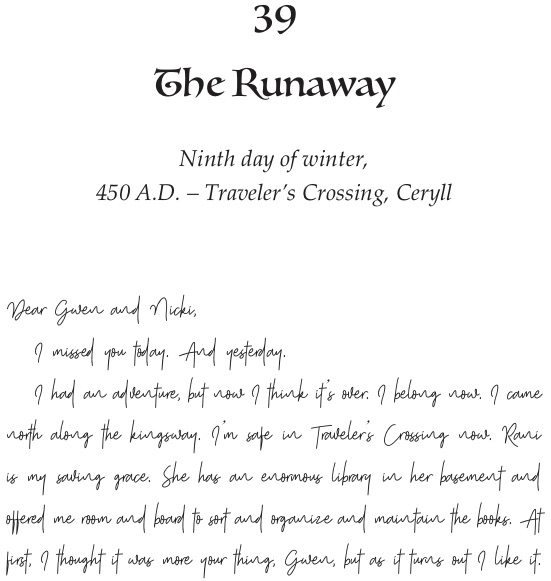
I added chapter 39 in November, after the book was well into the publication process. I was prompted by a cousin who remarked (without having read the book) that I shouldn’t have just one handwritten chapter.

I considered this out loud with her. I don’t remember the entire exchange, exactly, but I remember considering transposing Deric’s note to be its own chapter, then discarding the idea for some reason. It seemed important that the writing belong to Stelle, bookending the story with her writings.

Well, it’s no spoiler to tell you that that messes with the otherwise linear timeline of the book. Stelle’s first handwritten chapter is chapter 2; Gwen feels the effects of her death in chapter 3, which we then see in chapter 4. Thus, chapter 39, which is again Stelle’s writing, takes place in the timeline after chapter 2 and before chapter 3.

It also creates this morose, dreamy atmosphere that outlines and makes explicit much of what I feel was already there in the text or between the lines by chapter 38.

In terms of atmosphere, perhaps this is preferable to the cut-and-dry tone with which I otherwise portray grief throughout this book, I thought—yet at my core, I don’t like it. I never have. I like the descriptions of grief cut and dry.

In an earlier draft of this book, much more of the focus was on the grieving process. There’s a reason why I cut most of that out. The grieving process is very personal, and it’s hard for a reader to empathize with page after page of description of a grieving process that doesn’t match their own. This is why, though in my mind, Gwen’s grieving process is much the same as it was in that draft, the text is a lot subtler. It’s there, at times even explicitly, but hopefully now it’s been tempered enough to mitigate the barrier of personality.

Chapter 39 is a letter that Stelle wrote to her sisters while delirious with fever. It has some details about her life at the Crossing that this book would otherwise not mention, but mostly it’s a letter of love and regret. If ever anyone thought that Stelle carried the anger with her ever since leaving Castle Dio, chapter 39 dispels that.

And yet.

The more time passes, I don’t think it’s all that important. That Stelle’s anger has long been cold is there in the text of chapter 4.

I don’t like that there’s an entire chapter dwelling on her past regrets and pain—because, in the end, she isn’t truly past the anger. It may have gone cold, yes, but as we see in chapter 4, it’s easily ignited again. Stelle has only left her anger and pain behind—she hasn’t worked through them, or overcome them.

It took me 2 months to reach this conclusion. There’s been a lot of back-and-forth of “Should I take it out?” and “Should I leave it in?” While I was swaying back and forth, my book was published.

I don’t regret it: in a strange way, it makes me feel better about the over a dozen typos I’ve found in the published book. Because those typos exist, I feel better about asking to change an entire chapter, since I’m requesting all these other changes. But because chapter 39 will change, I don’t feel as bad about the typos: because now, there’s some reason for these books to exist. They may have a lot of typos, but they’re also going to be the only ones with this chapter.

So, if you disagree with me, and feel the book is better with Stelle’s chapter 39—it’s out there, and I can’t completely take it back.

(But the year is also wrong. It ought to have been 451 A.D. — so there you have it, yet another typo.)


Kai Raine is the author of the high fantasy series What Words Have Torn Apart, beginning with These Lies That Live Between Us.

Ebook is available at Amazon (US, UK, Germany, India, Japan, Italy, France and others) Kobo, Google Books and iBooks.

Paperback is available through Barnes and Noble and Amazon (US, India, UK, Germany, Japan, Italy, France and others).

.


Share this page:

  • Print (Opens in new window) Print
  • Email a link to a friend (Opens in new window) Email
  • Share on Facebook (Opens in new window) Facebook
  • Share on X (Opens in new window) X
  • Share on Tumblr (Opens in new window) Tumblr
  • Share on WhatsApp (Opens in new window) WhatsApp
  • Share on Reddit (Opens in new window) Reddit
  • Share on Pinterest (Opens in new window) Pinterest
  • Share on LinkedIn (Opens in new window) LinkedIn
  • Share on Telegram (Opens in new window) Telegram

Like this:

Like Loading...

Why I Write

Posted on January 7, 2018January 12, 2018 by Kai Raine

I believe that stories can set the mind free.

The largest portion of each of our minds is tightly constrained by the realities that it has experienced, and the beliefs of the cultures and societies that have surrounded it. This necessarily limits our ability to understand, and therefore accept, the experiences and beliefs of those with vastly different experiences, or from starkly contrasting societies or cultures.

I have heard this neatly summed up as “tribalism,” “preference” or “comfort,” but it’s so much more than even all three of those combined. It’s biology. Our brains are not designed to be accepting of all our fellow humans. Our brains are designed to survive, and we respond more strongly to fear, sadness and anger than we do to joy, comfort or happiness.

Even in love, often portrayed as the most positive of all emotions, many of us have internalized negative emotions as loving or romantic, because this is how our brains are hardwired to feel strong emotions; and because our culture, society and media have a tendency to propagate this. Pick up an average popular romance novel, and generally speaking, the driving emotions will feature jealous anger, fear of loss, sorrow of unfulfilled wanting, and/or sexual frustration. Sometimes, a character reveling in one of these emotions is even portrayed as noble.

This is not to say that this is bad, or wrong. But it is a pattern—a reality too often accepted without question. All too often I have heard people (women especially) complain about the abusive dynamics that would result if they were to take popular romance fiction tropes as reality. Even more often I have watched these tendencies unfold harmfully in reality before my eyes.

It doesn’t matter if our stories are that way because our brains are hardwired that way, or vice versa. (I’d guess it’s a bit of both.) The resulting effect is the same, though what those effects are will vary from person to person, and culture to culture.

Most of us don’t possess the natural capacity to shrug away these cultural norms and simply accept what we are taught is socially unacceptable. For example, this could be someone coming walking down the street naked, or a family member announces out of the blue that they are in a polyamorous partnership.

In fact, even if we do possess that natural capacity, as we get older, our brains grow less plastic. It becomes increasingly difficult to accept starkly different viewpoints that we’re encountering for the first time.

Young or old, this is especially difficult in reality. Certainly, there are any number of non-fiction books out there that would help us see how the minds works. But how many of us seek those out? In my experience, we tend to seek to read the views we agree with; when we read the views we disagree with, it usually seems to be for the purpose of figuring out how to counter those views.

I have no doubt that there are people out there who seek out the exotic and the new and the things they find instinctively repugnant with the intention of learning to accept and empathize with these views. I commend and admire these people.

I am not one of them.

Let me be clear: I do not advocate for cultural acceptance over legal action. If someone comes to from a culture where it is acceptable to murder someone over an insult, and that person commits murder, I believe that that person should suffer the consequences and go to jail. (Ideally, I would advocate for rehabilitating them to be able to live in a society without committing murder on the regular, but that’s another story.)

This is not because I believe murder is an inherently evil act. I believe our society and the people in it are much healthier and happier in a world where murders are not condoned.

As a person, I aim to be able to accept any act that does not do anyone harm of any kind.

As a writer, I aim to write compelling stories without bringing any of my own judgements to weight the scales. Should you read my stories and choose to judge my characters as good or evil, that is your choice—and, perhaps, the influence of the perspective of the character through whose eyes you are experiencing the story.

But I aim to make it difficult to easily call any one character purely “good” or “evil.” Instead, I showcase their humanity and tragedy, adversity and perseverance. Everyone is human. Everyone is flawed. There is only understanding and empathy, or the lack thereof. There are protagonists and antagonists, and I have no doubt that some of readers would overlook the protagonists’ flaws and the antagonists’ virtues.

That’s fine. I don’t hold my opinions and intent over anyone’s interpretations. I only aim to make it a little harder to simplify it into an “us and them” scenario.

I write my books first and foremost to be enjoyable to read. My debut novel is indie-published, but believe me when I say I put every effort into making sure it looked as good and read as easily as I could manage. Reading a novel shouldn’t be a chore, or homework. But as you enjoy the story and the plot and the characters, I will try to subvert your expectations—not to shock you, but to make you think and try to empathize with a character whose choices and beliefs have stopped following the expected narrative.

Sometimes these are based on things I wished I saw in stories more often, or indeed at all. More often than not, it’s what feels right for that character in that story when I break through some small part of my own mind’s barrier of what I think should be.

This is one of the reasons why, so far, I’ve written principally for a young adult and middle-grade demographic. Writing for these age groups means my characters are of similar age, and have minds that, while already holding some strong beliefs, can more easily accept that these strong beliefs are not consistent with new facts that come to light.

The effect that this style of writing has had on my psyche has been remarkable. I feel like I can see far more clearly than I ever could: not just my made-up worlds, but reality.

Come and join me in my world. Read my book, and tell me what you see.


Kai Raine is the author of the high fantasy series What Words Have Torn Apart, beginning with These Lies That Live Between Us.

Ebook is available at Amazon (US, UK, Germany, India, Japan, Italy, France and others) Kobo, Google Books and iBooks.

Paperback is available through Barnes and Noble and Amazon (US, India, UK, Germany, Japan, Italy, France and others).

.


Share this page:

  • Print (Opens in new window) Print
  • Email a link to a friend (Opens in new window) Email
  • Share on Facebook (Opens in new window) Facebook
  • Share on X (Opens in new window) X
  • Share on Tumblr (Opens in new window) Tumblr
  • Share on WhatsApp (Opens in new window) WhatsApp
  • Share on Reddit (Opens in new window) Reddit
  • Share on Pinterest (Opens in new window) Pinterest
  • Share on LinkedIn (Opens in new window) LinkedIn
  • Share on Telegram (Opens in new window) Telegram

Like this:

Like Loading...

These Lies That Live Between Us: Book Trailer

Posted on January 4, 2018 by Kai Raine

Three sisters: the heir, the airhead and the dead. Parting in anger, each attempts to confront the looming threat of invaders practicing forbidden magic in her own way. However, they soon learn that history is not so simple—much like their bond to one another.

This is the start of a fantasy epic about family, adventure, love, loss and the ever-changing interpretation of history long gone.

These Lies That Live Between Us is now available in ebook form at Amazon (US, UK, Germany, India, Japan, Italy, France and others) Kobo, Google Books and iBooks! Paperback is now available from Barnes and Noble!

Share this page:

  • Print (Opens in new window) Print
  • Email a link to a friend (Opens in new window) Email
  • Share on Facebook (Opens in new window) Facebook
  • Share on X (Opens in new window) X
  • Share on Tumblr (Opens in new window) Tumblr
  • Share on WhatsApp (Opens in new window) WhatsApp
  • Share on Reddit (Opens in new window) Reddit
  • Share on Pinterest (Opens in new window) Pinterest
  • Share on LinkedIn (Opens in new window) LinkedIn
  • Share on Telegram (Opens in new window) Telegram

Like this:

Like Loading...

Indie Publishing: A Summary of the Pros and Cons

Posted on January 3, 2018January 5, 2018 by Kai Raine

…as I have experienced them in publishing my novel through Gatekeeper Press. Let’s jump right in.

Pro 1:

Achieving a professional look while retaining complete (or as near as I could tell) creative freedom. The fonts, the cover art, and everything were all up to me to choose.

Pro 1.5

That said, I didn’t have to choose everything. If I didn’t give them specifics, GP has people who know what they’re doing who could work off of the basic information about the book.

Con 1:

Going in as a wide-eyed newbie to bookmaking, I learned that there were a lot of things that I never knew I had a preference about until I was sent something, and my gut screamed, NO!

Pro 2:

I was always able to request changes, and they would be made.

Con 2:

Asking for changes to a finished book file (which I ended up doing a couple times) does cost money, on top of the original fees.

Pro 3:

My author manager Takako was very nice about these costs, waiving fees where she could.

Con 3:

Because I was publishing through Gatekeeper Press rather than simply doing everything myself, there were some restrictions: for instance, sometimes I would want a certain font, but they would not have that licensed.

Pro 4:

With regards to the above “restrictions,” these were not insurmountable. For instance, if I offered to pay the licensing fee for a font, they would use that font.

Ultimately I didn’t do this, though I came very close. I was very picky about a handwriting font that went into the book. At the start I told them I didn’t care what font they used but it should look like “a wayward teenage girl,” but ultimately the font they chose just didn’t click with me. So I finally sent a list of fonts I liked and told them if they had none of those, I would pay the licensing fee for one of them. Fortunately, they had one font from that list, and used that.

Con 4:

I had no idea how picky it’s acceptable to be. (I still don’t know. I wonder if some of the people who had to deal with me and my learning curve are exhausted with the lists of changes I can demand now and then.) Ideally, I wanted to try to build these relationships so that if I decide to go this publishing route with the next work, I could happily work with the same people. I’m not entirely sure I succeeded.

Pro 5:

If I could articulate a question I had about the process, I could always ask my author manager at GP. It was okay that I didn’t know everything.

Con 5:

Because I knew nothing, a lot of my questions only came to me after the point at which it would have been ideal to ask it. Even now, I sometimes suddenly realize that there’s some detail that I never thought about and wonder, is it okay this way? Does it need to be changed? If I want to change it, between the fees and the work I’m making other people do, is it really worth it?

Most recently, this happened when I suddenly realized that the cover design isn’t credited to the artist on the copyright page. Of course—I never specified, because I never thought that was optional; and I never checked to see if it was there or not. But at this point, I’ve decided to let it go: the cover artist has seen the “final” version and didn’t mention it either, and there’s a page about her in the book, so the information is there inside the book.

Pro 6:

I really, really like the end result. (At least for the ebook, and the digital interior of the print book. I haven’t actually seen a physical print book yet.) I know I couldn’t have made it look like this on my own in this amount of time. Maybe I could have figured it out eventually, but the amount of stress it would have caused trying to figure out what I wanted it to look like when I didn’t know half these details would have been considerable.

Con 6:

It was frigging expensive. My book probably cost in excess of $2500 (this is an estimation because I haven’t yet been billed for all the changes made, or for the page count).

Don’t get me wrong: this was a choice, and I don’t regret it. I could have made it cheaper, but I didn’t. I had paperback and ebook formatting and distribution, a complete line edit, and probably close to 20 content changes (i.e. changes to the text after file is already complete) from Gatekeeper Press, plus an extra 10% on top of that to expedite the process (back when I thought I could get it out by Christmas). I paid an artist for the cover art.

All of this could have been done more cheaply, but I didn’t because I wanted it to look like a book I would pick up and read without knowing anything about it.

Pro 7:

Once I made the decision to do this, I could make it go fairly quickly. It took two months because of all the changes I kept wanting, which is already quite fast, but if I’d wanted fewer changes or known what I wanted from the start, it would have gone even faster.

Con 7:

Once the book is out, that’s it. You’re on your own. GP has no marketers or publicists, though they do say they can refer you to people they trust.

This is big. You can’t just publish your book and wait for it to sell—especially for someone like me, whose readership is still limited to people I know. It has to get promoted somehow, pushed out to a readership.

Marketing myself could easily cost me as much as it cost to make the book, if not more; but being too cheap in marketing could mean this book never reaches an audience beyond my circle of family and friends. Marketing myself effectively would take skill and experience. I’m still at the start of my learning curve here. Maybe in a year or two I’ll be in a position to talk about marketing as an indie author, but at this moment I’m not.

Honestly, I think it would be foolish to think about making money on this book. Yes, the listed prices are presently a touch higher than the costs of production. But as soon as there are other books published, I plan to drop the costs of this one to the cost of production. Currently, I view it as a foothold to use when marketing the next book.

If you happen to be someone who wants to help me in this, you can absolutely do that! Sharing and recommending my book on social media will help the book reach past my circle into your circle. If you’re someone who read and liked the book, I need (positive) reviews on Goodreads, Amazon, Barnes and Noble, and other such sites. Those are extremely valuable, because the presence/absence of reviews and the ratings can be the critical difference when one stray stranger comes across the book and is contemplating whether or not to buy it.

That said, I don’t want anyone to feel like they have to do this. If you write a positive review, please let it be because you liked the book, not because I asked you to.

If the book isn’t your cup of tea but you want to help me anyway, I’m looking to distribute my book by donating it to libraries in my area, and asking friends to do the same (I’ll provide the books). Contact me if you want me to send you a copy to donate to your library. Alternatively, if you can convince your library to purchase a copy, that would be even better! It will be (and may already be) available from Ingram, which distributes to libraries, and NACSCORP, which distributes to universities in the US.

Pro 8:

The reach of this book as distributed through Gatekeeper Press seems much better than I could have achieved on my own. As stated above, it’s available with distributors to universities, libraries and retailers, as well as all the usual sites like Amazon, Kobo, Google, iBooks and Barnes and Noble, which is great!

Con 8:

The reach of the book may have been even better had I gone through traditional venues.

Pro 9:

Having control over every step of this book including how it’s publicized makes me more driven to sell it, to get it to a larger audience. There’s no guarantee it would have succeeded no matter how it was published, and no one knows why this book is worth it better than I do. Traditional publishing would have meant that the book was out of my hands, and perhaps I wouldn’t have felt so strongly about it anymore after the editing and cover art and approach to marketing.

Probably if it had flopped, I would have shrugged and moved completely on to the next book rather than saying to myself, “Okay, that didn’t work. So what do I have to do to get this to people?”

I’m closer to my book now than I was even when I made the decision to go to Gatekeeper Press, and I’m determined to do everything I can to help it find its audience.

Con 9:

But if it had been traditionally published, I would have sold a lot more copies than I can dream of now, even if the book had flopped. I wouldn’t have born the costs of production, so any money lost wouldn’t have been my burden to bear.

Pro 10:

I retain all of the rights, and receive 100% of the royalties. This doesn’t mean much of anything right now, but in the unlikely instance that this book ever becomes middling to big, this will be a big deal. Then again, I’ve never been traditionally published, so maybe there are advantages already that I’m not aware of.

Pro 10.5:

Most of the cons, as you may have noticed, are about the financial burden, of a first-time-only variety, or about the financial burdens that resulted from my inexperience. If I were to go through this process again, I could mitigate some of them.

Ultimately, a lot of the financial stuff comes down to a time vs money question: which would I rather save? If the answer is money, then I have to be careful not to overload myself, because this could easily become overwhelming and crushing both mentally and emotionally. I was aware of this, which is why I chose to pay to have a lot of it done for me this time around.

But having done it once, I feel that there are some things (like formatting the interior for the print copy) that I’m sure I could manage myself without having to pay for it next time. This would also ease the burden of constantly asking for changes.

Having done this once will especially improve the way I approach marketing next time. Now that I have one book published, as long as I keep trying to get it out to a larger readership, maybe in another novel or two I’ll be able to start thinking about earning money on my work.

If I were to do this again….

I’d start focusing on marketing and publicizing the book more than a couple weeks before it comes out. Which means I’d also not bother trying to rush publication. That time could have been valuable if I’d focused on using it to build hype.

I’d go into formatting with a list of fonts I like for absolutely every part, or at least my preferences (like that there should be serifs, even on headers)—or I’d do it myself.

I’ll think about details like chapter headers before I submit the manuscript.

I’d submit an ARC to reviewers. I’d do some sort of event on the date of publication, trying to sell the books in person.

Related to making sure there was less rush, I’d make sure there was less stuff on my plate. Trying to do holidays and make a book all at once was a lot.

It would probably be smart to hire editors twice next time: a developmental edit after I feel like I like the manuscript, and a line edit when I’m ready to publish (because I assume there would be a lot of editing in between).

In summary…

It’s frigging expensive, and frigging scary. At the moment, it’s looking more like a money-draining hobby than a career.

But that’s ok. My goal going in was that if I can reach 100 readers I don’t personally know who genuinely like my book, that’ll be enough for now. That’s nothing if I want to make any of the costs back that I put into the book; at the same time, it feels like a ridiculously lofty goal right now. Lofty, but (I hope) achievable.

These Lies That Live Between Us is now available in ebook form at Amazon (US, UK, Germany, India, Japan, Italy, France and others) Kobo, Google Books and iBooks! Paperback is now available from Barnes and Noble!

Share this page:

  • Print (Opens in new window) Print
  • Email a link to a friend (Opens in new window) Email
  • Share on Facebook (Opens in new window) Facebook
  • Share on X (Opens in new window) X
  • Share on Tumblr (Opens in new window) Tumblr
  • Share on WhatsApp (Opens in new window) WhatsApp
  • Share on Reddit (Opens in new window) Reddit
  • Share on Pinterest (Opens in new window) Pinterest
  • Share on LinkedIn (Opens in new window) LinkedIn
  • Share on Telegram (Opens in new window) Telegram

Like this:

Like Loading...

Beginning My Journey in the World of Indie Publishing: Why Indie Publish?

Posted on January 2, 2018January 3, 2018 by Kai Raine

As you may be aware, my first novel, These Lies That Live Between Us, came out today. It’s thrilling and exciting, but also frightening. One of the reasons it’s frightening is because I chose to go the route of indie publishing. I’d like to share some of the lessons I’ve learned over the course of this journey, but first I have to start with the question: why indie publish?

The internet seems to be awash with people with strong feelings about indie vs traditional publishing. Some declare that traditional publishing is dead or too biased in favor of established names and commercialization. Others declare that authors who indie publish are people who didn’t want to put in the work to be accepted through traditional routes, or whose book simply wasn’t good enough.

I used to feel that traditional publishing was the only way to go. It was San Francisco Writers’ Conference 2017 that changed my mind. I met agents, publicists, indie authors, and indie publishing companies there, all of which contributed to my understanding that this will be an uphill battle no matter which route I should choose to take. There are pros and cons on all sides, and ultimately all that rests on me is to make a decision.

I received cards from four agents at the “speed-dating” event intended for authors to find an agent at the conference. I left the conference with the resolution that I would pitch to the four of them, and if they all rejected me, I would self-publish.

I sent to three agents and got rejected. I never submitted to the fourth, whom I had saved for last, because she was my first choice and I felt so sure that if anyone will take it it’s her. (The idea was that if the other three rejected me, I would learn and perfect my pitch before it got to my first choice.) I lost her card with the instructions for my submission, and was frighted of being rejected simply because my query hadn’t fulfilled her requirements stated on the card.

Then, one fine day in early November, I realized—I could publish at the end of the year and take another novel to SFWC 2018. Maybe I could have it published by Christmas and convince people to buy it as gifts. (Eventually the Christmas deadline was abandoned in favor of a more realistic one that allowed for corrections, of which there were many.)

Most likely, one of the factors that contributed to this decision was the length of time that I’ve been shopping this manuscript around. I’d been agent-hunting for a solid year, without even a manuscript request. Even at the conference, some agents in casual conversation explained to me that the premise of my book sounded unmarketable—too cross-genre to have a clear target demographic. I couldn’t deny it: even as I market it as a YA novel now, I’m frightened of the disappointment that some readers might suffer when they realize that it doesn’t do what they expect—most particularly because none of the “romances” will lead anywhere.

Of course, looking at the facts in retrospect, I see an entirely different picture. My pitch improved dramatically after the conference, but I only sent to three agents after that point. In the middle of submitting to these three agents, I cut over thirty thousand words of internal monologue and other nonsense, and added a third storyline. The first fifty pages changed dramatically in September 2017, and I never submitted to another agent after that.

Above all, with everything I learned at the conference, my story has gone from having potential to being great. I’m not trying to brag or sell myself, though you may not believe me. It astonishes me, the changes that those eight months brought to my story. If I had to estimate, I’d say that 80% of the book was rewritten in those eight months. In many ways, it isn’t the book I brought into the conference anymore. I was proud of that book, but editing it was an exhausting chore. I love editing this new one. Even when I start out not wanting to, the story sucks me in and I have trouble stopping.

That’s never happened to me before with something I’ve written. I didn’t think it was possible to enthrall myself with my own words and my own story.

So perhaps my mistake was not submitting to agents after all these edits were made, and I knew beyond a doubt that I written something worth reading. Maybe if I’d done that, I’d now be starting a journey into the world of traditional publishing. Or maybe I’d still be sending my pitch around, writing and rewriting it ad infinitum.

The fatigue of a year of rejections wasn’t so easily reasoned away by confidence in my new and improved manuscript, especially when there wasn’t a single voice around me supporting traditional publishing. The voices around me were instead urging me to self-publish and put an end to this so I could move on to the next work and asking when this book would be published. I can say without a doubt that the voices around me became the determining factor that effected my decision, for better or for worse.

And so the decision was made.

The only caveat I had about self-publishing was that if I was going to go that route, I needed my book to meet professional standards. No one picking up the book would know that it was self-published just by looking at it, or by reading it.

So I turned to Gatekeeper Press. I met Rob and Tony at the conference, and even there and then was strongly compelled by their style. From the moment I made the decision to self-publish, I knew I would do it through them. Gatekeeper Press is at its core a distributor—they make sure the book ends up on every ebook retailer it can—but they offer every step of the publishing process for a flat upfront fee, including cover art, formatting and editing.

The same day that I decided to abandon the last agent and self-publish, I emailed Rob and scheduled an appointment with Tony on their website. Five days later, I signed on with them.

Now, less than two months later, I’m a published author! I understand the world of publishing a lot better than I did even a mere two months ago. I’m glad I made this decision, and hope this book eventually finds a readership that loves it as much as I do.

These Lies That Live Between Us is now available in ebook form at Amazon (US, UK, Germany, India, Japan, Italy, France and others) Kobo, Google Books and iBooks! Paperback is now available from Barnes and Noble!

Share this page:

  • Print (Opens in new window) Print
  • Email a link to a friend (Opens in new window) Email
  • Share on Facebook (Opens in new window) Facebook
  • Share on X (Opens in new window) X
  • Share on Tumblr (Opens in new window) Tumblr
  • Share on WhatsApp (Opens in new window) WhatsApp
  • Share on Reddit (Opens in new window) Reddit
  • Share on Pinterest (Opens in new window) Pinterest
  • Share on LinkedIn (Opens in new window) LinkedIn
  • Share on Telegram (Opens in new window) Telegram

Like this:

Like Loading...

Recent Posts

  • Redefining “Which Quarantine House” Memes
  • The TLTLBU Sequel Woes
  • The World Wide Web (No, the Other One)
  • Hello, Blog Readers…
  • A Quick Guide for Writing Diverse Characters (Whose Backgrounds You Don’t Share)

Recent Comments

  • Cliftonguest on Route 2: The Highway That Was My Personal Obstacle Course
  • Kai Raine on Mt. Kawanori Hike (Including Hyakuhiro Falls)
  • Edith on Mt. Kawanori Hike (Including Hyakuhiro Falls)
  • Kai Raine on Mt. Kawanori Hike (Including Hyakuhiro Falls)
  • Onlinepharmacycanada on Mt. Kawanori Hike (Including Hyakuhiro Falls)

Archives

  • April 2020
  • February 2020
  • April 2019
  • December 2018
  • November 2018
  • October 2018
  • September 2018
  • August 2018
  • July 2018
  • May 2018
  • April 2018
  • March 2018
  • February 2018
  • January 2018
  • August 2017
  • June 2017
  • May 2017
  • April 2017
  • March 2017
  • February 2017

Categories

  • Cognitive Science for Writers
  • Eating and Cooking
  • Hiking and Nature
  • Indie Publishing & Marketing
  • Interesting Strangers
  • Keeping Ahead of the Shadows
  • Murphy's Law of Transportation
  • Stories and Me
  • The Othered
  • Travel Stories
  • Writing for a Globalized Audience

Meta

  • Log in
  • Entries feed
  • Comments feed
  • WordPress.org
© 2026 Kai Raine | Powered by Minimalist Blog WordPress Theme
%d