Kai Raine

Author of These Lies That Live Between Us

Menu
  • About Kai
  • Books
    • These Lies That Live Between Us
  • Short Fiction
  • Non-Fiction
  • Media & Events
    • Contact Me
  • Blog
  • 日本語
  • Reviews & Interviews
Menu

Author: Kai Raine

Belonging: My Greatest Love Story

Posted on April 13, 2018April 13, 2018 by Kai Raine

Recently, I’ve read Born a Crime and One Day We’ll All Be Dead and None of This Will Matter. Both collections of very personal essays. Both very resonant with me, personally. Both with very strong themes about belonging in a society where the authors are seen as Other.

I used to want nothing more than to belong.

As a child, it seemed like the most beautiful, magical thing, belonging somewhere.

I felt it in preschool in Massachusetts, when a lesson meant to teach tolerance instead made me realize that I was one of only two nonwhite children in the whole school.*

I felt it through my childhood in Tokyo, where my oddness was made fun of by everyone from my Japanese classmates to the children attending the American School, whom we saw at the church we attended; where people would stare at me openly in the streets and people at cash registers would look at me in horror at the thought that they might have to speak English.

Our vacations in the US started out as a refuge, but grew worse and worse year after year as the summer schools my parents sent me to only served to highlight how I didn’t belong here, either. I was often confused. Knowledge was assumed of me that I didn’t have—like what the pledge of allegiance even was, much less the words to it. It usually ended with me having at most one friend, and otherwise ostracized.

I was often angry. I cried a lot. I blamed the world, and sometimes my parents, for robbing me of a place to belong, which I thought I deserved. I daydreamed of a place to belong, or when that seemed too far-fetched, at least some imaginary perfect person with whom I could belong.

And now?

I can belong most anywhere—some places more than others. I look at my childhood fantasies as just that: fantasies. And like all childhood fantasies, they can come true—but not in the form imagined as a child.


The Myth of Belonging

Three years ago, I lived in Germany and was frequently visiting the Bay Area in California.

I didn’t know much about California at the time. My experiences living in the US were mainly Buffalo and Fairbanks, with a sprinkling of memories of a happy childhood in suburban Massachusetts.

Still, based on those years of experiences, I had one general certainty: I did not want to live in the US.

So it was a little alarming to me that I kept finding myself in conversations with people offering to help me find a job in California.

This was before I dropped out of my PhD program in Germany. I had a steady income—not a lot, but enough that I could save about 500 Euros a month if I lived frugally, which I did. I had great health insurance. I loved the city I lived in. My personal life was at the start of a downward spiral, but that couldn’t be mitigated no matter where I lived.

Yet I was perceived to be lacking something that could only be gained by moving to California. It was disconcerting.

I was slow to learn that there was nothing to be gained by trying to explain my perspective. My explanations were almost always taken as a personal challenge, or insult. If I said I didn’t enjoy living in the US, I was asked to explain why; but my explanations were usually met with “But it’s not like that here,” or “But I’ve never experienced that,” or even “But that’s such a generalization.”

Needless to say, arguing does not usually result in one person adopting the other person’s experience over their own. And that’s all it was: a dissonance of my experiences to those of others.

At one point, one person graced me with the frankest, most honest version of this conversation, which was the most enlightening in hindsight:

“You know, my brother works at this company in your field,” she was saying to me, “I can refer you to him, and you can apply for a job there.”

“I’m not really looking to live here,” I replied awkwardly. “And I mean, there’s still no end in sight to my PhD…”

“But you wouldn’t need one to work there,” she enthused. “They hire people out of their bachelor’s and master’s all the time. And you can always do a PhD through them!”

“I don’t think I’d like that. I’m happy where I am.”

She looked at me incredulously. “But you’re in Germany!”

I blinked. “Yes.”

“You’re an outsider.”

I stared at her. “I’m no less an outsider here,” I said.

She grew agitated. “But you can belong here! I mean, you’re American! And anyone can be accepted here, anyone can belong.”

“I can belong in Germany,” I said.

She was really agitated now. “You can’t,” she told me firmly. “You’ll never be German.”

I started to tell her that I was pretty sure that there are ways to get German citizenship, and she cut me off.

“Yes, but they’ll never really accept you. You’ll never be German like they are. Not like here. Here, anyone can belong. Everyone is equal.”

I don’t remember how the conversation ended. Maybe I continued arguing, or maybe I shut my mouth and fumed in silence. I remember the bitterness in my mouth, and the sting of angry tears. I remember what I didn’t say, even as the memories cluttered my mind: horrible things I’ve heard Americans say about immigrants who’d gotten US citizenship. Horrible things I’ve heard Americans say to and about me when they realize that I might look like an American and talk like an American, but I don’t think like one.

It was such a source of frustration at the time. I felt attacked and lonely, like my face was being rubbed in a reality where I can’t ever belong anywhere. That my best bet would be to pretend at belonging in the US until the act felt real.

Here’s the secret I’ve since discovered how to articulate: belonging is only a fraction about whether people accept you. It’s really mostly about you, and your relationship with that place.


The Death of Homesickness

I grew up in the suburbs of west Tokyo. I’m living here again now, as of last week. It’s been fifteen years since I lived here. Fifteen years of living in place after place that either became my home, or didn’t.

In these fifteen years, my reserve of homesickness was painfully drained, squeezed to the last drop, and then squeezed some more until that very capacity shriveled up and crumbled to dust. I don’t feel homesickness anymore. When I leave Japan, I have no strong longing to return. I never feel any longing to return anywhere. I’m either happy where I am and I want to stay, or I’m not happy where I am and I want to get away.

This happened because Japan was my home. It was the home where I was not allowed to belong, to which on my return, even my friends tended to highlight my foreignness, expressing surprise when I would say that Japan was what I thought of as home. Yet circumstances conspired to give me a 9-year period during which I could not even visit—during which I frequently went without speaking Japanese for months at a time. There may have even been a solid year in there when the Japanese language was entirely absent from my life.

Over the 9 years, the ache grew, at first. The last time I’d visited Japan had been 3 years after the time before that—an interval that seemed cruelly long at the time. I felt certain that somehow, I would not have to wait more than another 3 years. Those 3 years came and went, and I didn’t visit. I was in university, up to my ears in debt. I thought about applying to grad school in Hokkaido University and emailed a professor, who was not exactly encouraging.

I went to grad school in Italy instead. When I wanted to do an internship, I searched for something in Japan and found nothing appropriate. So I went to Namibia, then to Germany.

I started my PhD and was too poor—both in money and time—to plan any sort of trip to anywhere, much less Japan. My supervisor was excited about my bilingualism, and asked me to email a partner lab in Japanese. I did so. Uncertain of the level of formality required between professional adults, never having been an adult in Japan, I went full throttle with the formality. Though we did keep up a correspondence and had no trouble understanding each other, they said to my supervisor when they next saw him that my Japanese was quite odd. He related this to me, and I instinctively blamed it on typical Japanese xenophobia. The shame was immediate, and in its wake, I was resigned. Perhaps this was not my identity, after all.

It was the seventh year when I started to feel that part of me die. The ache and yearning I’d felt deepening and intensifying year after year began to dry. Increasingly, I just didn’t care anymore.

I stopped trying to keep up with my Japanese friends. I stopped going out of my way to find Japanese books to read. Most of the time, I thought of Japan with a vague sense of past love.

By the eighth year, I no longer claimed I was from Japan. I’d say I was from America, when asked. Never mind that I couldn’t identify as American. I couldn’t identify as anything anymore, and American seemed as good as anything. At least I had the passport to make my case, and what else matters?

In the ninth year, I seriously considered not even bothering coming back. I was fine now, I thought. What if it turns out I’ve forgotten my Japanese? What if it doesn’t feel like home anymore? What if after I leave, the homesickness just comes back at full blast? How can I go through that again?

Obviously, something else won out and I made that visit anyway. None of my fears came to fruition. My Japanese was still fully intact, if a bit rusty. It still felt like home, a marvelous feeling that I hadn’t even remembered I’d forgotten. And after I left, the homesickness was numb and gone in a matter of weeks.

Thus began a pattern. I would come for a visit, remember how much I loved it, try to find a way to stay, fail, leave, and forget about it until I came back again. This until eventually, I found something, and got to come back for real.


Home — The Reality

So I’m home now. It’s lovely. People I know welcome me home. People I don’t know treat me like a visitor, at first. And it’s fine.

I’ve been here ten days, working out bureaucracy, and this is a dialogue that I’ve been having, in some variation, on a daily basis:

They begin speaking in English.

I respond in Japanese (either responding or asking them to repeat themselves in Japanese).

The conversation continues in Japanese.

At some point, they say to me, “My, your Japanese is really good!”

I respond, “Thank you, I grew up here.”

Sometimes, they continue praising my linguistic skill, comparing me to foreign residents who don’t speak the language. I listen politely. Sometimes, they give me a look that makes me wonder if they think I’m lying. I ignore this, they ignore my “lie,” and the conversation moves on. And sometimes, they accept my explanation with haste after that moment of surprise, even apologizing for their remarks. To this, I tell them there is no need and sometimes apologize back.

At one time, that third reaction would have made me happy. Now, the contrition makes me feel guilty for making them feel bad when they were only trying to be helpful; I wonder if I shouldn’t have just played the foreigner and gone on speaking English. Sadly, the reality is this: I’m terrible at understanding Japanese English accents, because in all my life I’ve almost never spoken in English with a Japanese person.

(I had a Japanese roommate in my last semester of university. Recently, I met her and we had dinner with my father. During the dinner conversation that consisted of much English, we realized that we’d never really spoken with each other in English before, in all the time we’ve known each other.)

This happens on the phone, too. Conversations progress normally up until the moment when I have to give my name, at which point there is a pause of surprise, followed by a tentative, “And who is it I’m speaking to?” or a knee-jerk, “What country are you from?”

And it’s all fine. It’s repetitive, but unsurprising. None of this detracts from any sense of belonging for me. Strangers’ reactions carry almost no emotional weight for me—at most, a drop of frustration that quickly dissipates. Trying to spell my name over the phone is a far bigger frustration. (My real name, not my penname. My real name is a nightmare to spell and to pronounce in every language I know—hence the penname.)

I know that I belong, and my friends know that I belong. That’s more than enough.

The town where I grew up is far more diverse than it was when I was a child. Walking down the street on the average day, I almost always see someone who looks distinctly not-Japanese. It’s a far cry from the days when every morning one April that I was on time walking to school, I would inevitably pass the same preschooler waiting for his bus with his mom, who would point and shout, “Look, it’s a foreigner!”

But I’ve changed, too. Belonging isn’t something I’m waiting to have bestowed upon me, like some gift society can give me. It’s something I find for myself. It’s fragile and not necessarily everlasting, but beautiful and precious while it lasts.

In many ways, my new life is a poetic echo of my childhood dreams. As a child, I lived in an apartment in an ugly old concrete building with a sinking ceiling and sections of rotting floor, on the third floor, in the second apartment from the right. (My mother described it in the kindest, tamest language she could, which was “seemed to be literally falling apart.”) I desperately wanted to live somewhere nicer, preferably one where the outer façade looked like bricks.

Now I live in a lovely apartment building with a brick façade, on the third floor, in the second apartment from the right. Those childhood yearnings aren’t mine anymore, but I remember them. I know that little me would have been happy to know that one day, she would live in this place, in an apartment just like she’d dreamed. I’m very much aware that I’m living her dream. I even have no trouble belonging here, this time.

To me, it’s an amazing thing when a love long gone can be reignited years later, changes wrought by time only having made the two parties more inclined to fall in love again. So it is now amazing to see this love come alive again, even if one party is myself and the other is a little suburban town.

And I belong.


*My enlightened-preschooler sense of race revolved primarily around skin color, so I’m pretty sure that far-east Asians would have counted as “white,” though I’m not sure if there were any.

Here’s where I’d normally ask you to subscribe to my mailing list, but MailChimp suspended my account a month ago for a “ToS violation” that’s probably just an accidentally triggered algorithm. I contacted them immediately, but they haven’t gotten back to me yet. You can still subscribe, but you won’t receive any notifications until this is resolved.

Instead, I invite you to engage in the comments, or contact me directly if you’d be more comfortable with that!
Share this page:

  • Print (Opens in new window) Print
  • Email a link to a friend (Opens in new window) Email
  • Share on Facebook (Opens in new window) Facebook
  • Share on X (Opens in new window) X
  • Share on Tumblr (Opens in new window) Tumblr
  • Share on WhatsApp (Opens in new window) WhatsApp
  • Share on Reddit (Opens in new window) Reddit
  • Share on Pinterest (Opens in new window) Pinterest
  • Share on LinkedIn (Opens in new window) LinkedIn
  • Share on Telegram (Opens in new window) Telegram

Like this:

Like Loading...

Emotional Autobiographical Writing

Posted on April 1, 2018April 1, 2018 by Kai Raine

I just started reading One Day We’ll All Be Dead and None of This Will Matter by Scaachi Koul. It’s a brilliant book, a collection of personal essays by the Canadian daughter of Indian immigrants. Obviously, in many ways I can relate.

But it struck me that Koul’s ability to take her own life and tell her stories with honesty and emotion while still being able to make fun of herself, her family, and her friends is an amazing, impressive skill.

I tried to do a similar thing yesterday, though it was less a story and more part of my mental health blog. Yeah, I thought to myself, I come across as too angry, pretentious, accusatory. How is it that Koul can write herself and come across as so self-aware and engaging, while I probably come across more like a child stomping my foot?

I think it’s a skill, and for me, it means having to train two separate skills.

The first is learning to explain my actions and thought process and behavior and emotions to myself. There’s usually an existing framework, an existing understanding of those things; but it isn’t always the best one. This is the element that makes autobiographical content easiest to write years in hindsight, when I can step away from the emotions and my then-interpretation of the situation to perhaps see more clearly.

The second is learning to talk about my life in a way that makes it fun and engaging and relatable for other people. Some may say this is just a generic writer skill, but I disagree. It’s rather different when you’re writing about someone else or a story in your mind, versus when you’re trying to write about yourself. Again, I think that this is something that time aids a great deal: if enough time passes, we can look at our past selves as if they were other people, and that distance makes it only a little harder than other stories. But writing about oneself in the present, when the person on the page is supposed to represent exactly who you are?

It’s terrifying, and it’s difficult. Just because we can accept that we are flawed in certain ways doesn’t mean we can write those flaws in an engaging and relatable way. If we’re appealing to the reader for their understanding, their acceptance—this probably comes across the page, or the screen. This probably is something that creates more skepticism in the reader, rather than less.

It’s these elements making my entire Keeping Ahead of the Shadows experiment the least relatable of the things I write, I think—unless you’re going through the exact same thing, and can give me the benefit of the doubt when I misstate something or misrepresent something.

It is a skill I’d like to train, though. My purpose, as a writer, is questioning assumptions—including assumptions about myself. This may seem to contradict yesterday’s post somewhat, but I want to be able to question things, without being thrown off balance and down a depression spiral if I lean a millimeter too far.

In a few decades, age will help me in this, I think. When my neurological pathways are more settled, less plastic, I’m sure I’ll be able to better hold myself firm. (At the same time, I’ll probably be less able to fold my mind against someone else’s, the way I still sometimes can.)

It’s a complicated thing to do, autobiographical writing. What matters to me? What would matter to readers? What seems important to me, that isn’t to readers? What seems unimportant to me, that is important—or even crucial—for readers to understand where I’m coming from?

This is one of the reasons why I’ve been updating this blog less and less.

Meh, maybe I should try vloging instead. Maybe I should stop trying to write about my own life, and focus on my fiction. Maybe it’s just one of those things I have to stick to, that will improve dramatically with time and practice.

Share this page:

  • Print (Opens in new window) Print
  • Email a link to a friend (Opens in new window) Email
  • Share on Facebook (Opens in new window) Facebook
  • Share on X (Opens in new window) X
  • Share on Tumblr (Opens in new window) Tumblr
  • Share on WhatsApp (Opens in new window) WhatsApp
  • Share on Reddit (Opens in new window) Reddit
  • Share on Pinterest (Opens in new window) Pinterest
  • Share on LinkedIn (Opens in new window) LinkedIn
  • Share on Telegram (Opens in new window) Telegram

Like this:

Like Loading...

Why I Vote Now—And Why I Didn’t in the Past

Posted on March 14, 2018March 16, 2018 by Kai Raine

This is not going to be a sermon on why we should all vote. I want this to be clear from the get-go. As I state in the title, I haven’t voted in the past, despite being eligible to do so. I don’t regret that decision in any way—nor do I regret the choice I eventually made to register and vote. I’m not here to offer judgement or advice—just my story.

As a Child…

Civic duty and patriotism weren’t exactly subjects of discussion in my home, growing up. Civic duty was a thing I learned in school, but in the context of Japan—and being the only non-Japanese there, there was a silent understanding that I was an outside observer in these duties.

I would be an adult before I would be able to see how my parents’ views guided and confused mine, because my parents’ views were never explained to me. My father is a naturalized US citizen, but never expressed any particular attachment, neither to the US nor to India where he was born and raised. His naturalization, he once explained to me, was simply a practical decision when I was born—better that everyone in the family share a nationality. My mother was born and raised in the US, and so civic duty was important to her—but in a way that seemed so obviously common sense to her that she never vocalized it until I completely derailed from her expectations of common sense.

We learned in school that it was important to stay abreast of the news, but my family did not have Japanese newspapers delivered to us—we had an English newspaper. We didn’t watch TV. Our newspaper was our source of news, and it appeared to be geared toward the more internationally-minded. So the news I would read about would not be the same news my classmates would read about. Reading Japanese newspapers would have been extremely difficult for me as a third- fourth- and fifth-grader, with too many characters I didn’t know how to read yet, and no one at home to help me. It seemed that reading our English newspaper only highlighted my otherness more than it already was on a daily basis—so I quickly decided not to bother with it at all.

When my mother occasionally freaked out about news, distressed and hand-wringing, I watched with a detached bewilderment. When Bush was elected in 2000, I was baffled at my mother’s frustration over some leadership dispute an ocean away in another world. When 9/11 happened, my mother was beside herself, panicking and rushing to make phone calls.

“But do we know anybody in New York?” I asked, confused.

“No,” my mother snapped tersely.

“But then why are you so upset? This sort of stuff happens all the time,” I said, thinking of the then-ongoing genocide in Sudan, which had been in the papers for months and had a much higher death toll than this one attack in New York.

My mother called me spoiled in a tone I’d never heard from her before. I shut my mouth and judged her for so unabashedly prioritizing strangers in New York over strangers in Sudan.

As a Teen…

Eventually, I moved to the US. Still my understanding of politics was limited.

In high school in Buffalo, NY, I finally dared to ask the meaning of these strange variations on the words democracy and republic. A classmate kindly explained it to me, with the air of someone glad to be in the position of knowledge, but confused at this basic lack of understanding in me.

“It’s like, if you’re a democrat, you believe in abortion and not the death penalty. If you’re a republican, you believe in the death penalty and not abortion.”

“But what if I believe in neither abortion nor the death penalty?” I asked, every bit the wide-eyed teen.

“You can’t do that,” said my classmate impatiently. “I mean, I guess you could be independent? But it’s better to pick one or the other.”

Well, clearly this was a ridiculous system. I decided that I was independent, and it would be a waste of time to learn any more about this party business.

The 2008 Elections

The 2008 elections were the first where I was eligible to vote. In 2008, I lived in Fairbanks, Alaska and I didn’t have a car. Therefore, I didn’t vote.

I’ll elaborate.

Fairbanks, AK has an abysmal barely-there public transportation system, and it was even worse in 2008. There were 4 bus lines, and they mainly operated on a schedule of once an hour during normal business hours. The margin of error with regards to the schedule was, in my experience, +/- 1hr. I was once left standing out in the -40º Alaska cold by the side of a road for over an hour, at which point the bus I’d been waiting showed up with the next bus immediately behind it. I would have already been at my destination had I chosen to walk, but it was cold and I didn’t want to miss the bus between stops.

To register to vote, I would have needed to take one of these buses, and then take it back. It would have to be on a weekday, so I’d have to work it in with my class and work schedules. To be out in town entirely dependent on the bus schedule to return felt like a terrifying prospect.

Furthermore, it was Alaska. McCain was running with Sarah Palin as his running mate. What was the point in voting? The state would go to McCain regardless.

Why Should I Vote?

When my mother learned that I hadn’t voted, she made her disapproval clear.

“Why should I vote?” I asked. “They don’t let random Japanese people vote. Why does it make sense for me to vote?”

My mother shook her head mutely. Her disapproval was palpable, as was the air that she thought that I was being cheeky, and so wouldn’t dignify my question with a response.

But my question was entirely sincere. People in the US, I had learned during my time in Buffalo and Fairbanks, seemed singularly concerned with the right of foreigners to have a say in the running of the US. I, it seemed to me, didn’t have the right to a say in a country I felt I barely knew.

For years, whenever the question of voting came up, I would pose the question to people: “Why should I vote?”

“It’s your duty as a US citizen,” some would say.

“It’s wrong not to,” others would say.

“If you don’t vote you’ve got no right to complain,” still others would say.

None of these was an argument—just guilt trips. So I disregarded them. Sometimes, the same people who would tell me these things would also voice the opinion that immigrants with insufficient time or experience in the US should not be allowed a voice in these elections. To me, it seemed odd that I should vote because I happened to be born on US soil, while the person who voluntarily chose the US should not.

I didn’t vote, and I don’t regret it.

Then, one day in Namibia when the 2012 elections were approaching, one of the leaders in my research group at last offered me a different argument:

“We’re each only allowed say in the running of one—maybe two—countries in the world. We have so little say in how the world is run. So we should use what voice we do have to the fullest.”

The moment she said it, I felt that it was true. At the earliest opportunity, I registered myself to vote as an overseas resident—a process more complicated than I would have liked, given that I’d never legally resided in the US as an adult. I voted in the 2012 elections and have continued to do so in the elections where I was eligible to vote ever since.


Subscribe to my mailing list! No spam—I promise.

Share this page:

  • Print (Opens in new window) Print
  • Email a link to a friend (Opens in new window) Email
  • Share on Facebook (Opens in new window) Facebook
  • Share on X (Opens in new window) X
  • Share on Tumblr (Opens in new window) Tumblr
  • Share on WhatsApp (Opens in new window) WhatsApp
  • Share on Reddit (Opens in new window) Reddit
  • Share on Pinterest (Opens in new window) Pinterest
  • Share on LinkedIn (Opens in new window) LinkedIn
  • Share on Telegram (Opens in new window) Telegram

Like this:

Like Loading...

Trapped in My Mind: Big Picture, Little Picture

Posted on February 24, 2018February 24, 2018 by Kai Raine

I’ve always felt a little bit trapped in my own mind. It frustrates me endlessly that while I can flip a switch in my brain to understand  any perspective, I can only view one perspective in depth at a time. Generally, since I must be at least a little biased, I let my bias be in favor of my own perspective.

I’m also a fan of character-driven stories. Even if a story is genre fiction, it’s the characters that I hone in on—their ups and downs and the way that they think and perceive and learn and grow.

What this means, in essence, is that my reading niche is a place where stories have fleshed out characters with all the little details to show me who they are and who they are becoming, but also allow for a sense of the bigger picture.

In the final stages of editing/rewriting These Lies That Live Between Us, I was watching and reading a lot (and I do mean a lot) of One Piece. In a mindset where I was finding it hard to focus on—much less enjoy—any other author’s creations, One Piece simply clicked, as it always has since I first discovered it at age ten.

I analyzed this, and recalled the way that my attitude changed with regards to TLTLBU in the many different forms that it has taken over the years.

In my first post-publication review of TLTLBU, I received a positive review (not posted publicly) that contained the following feedback:

I had a hard time trying to follow the story line in a few places because there were too many characters. Fewer side characters would help and more development of the main characters to get to know them better.

Honestly, I’m surprised I didn’t get more feedback like this. There’s a lot going on in TLTLBU, and a lot that is left unstated—merely implied, or left out of the text altogether. Notably, that Nicki’s storyline is told entirely from other characters’ POVs, with the only character used more than once being Dara—I knew that I risked alienating some of my audience by doing this.

I did it anyway because it felt right. To me, Nicki’s story is much more fun when you the reader don’t know what she knows or is planning. It’s thrilling and intriguing in a way that mounts and climaxes toward the end, in a traditional and time-tried fashion. In contrast, if I were to tell that same storyline from Nicki’s perspective, the tension would be highest when her father throws her in the tower. After that point, even though she is caught off guard a few times, things generally go her way—which is great for Nicki, but not very exciting to read if we’re in her head.

I did consider telling that whole storyline from one other person’s perspective—Manon, perhaps, or Odilon or Hervé or even Enri—but I didn’t feel that was right. Making any of these characters the primary POV for that story would have conflated their role in the story. If I did that, then in later books, when I begin to use Nicki’s POV, I would have to create an all-new storyline for the former POV character so that he or she didn’t simply fall out of the role of protagonist.

I could have done it, certainly. But What Words Have Torn Apart is, at its core, about the three sisters. If you’re wondering why, then, Alderic was permitted the role of protagonist: his role as a member of the king’s guard means that his storyline, unless he deserts, will always run parallel with the Ceryllan royal family. After the events of TLTLBU, his storyline is even more entangled with the sisters’. This is why I could comfortably make him a protagonist when needed.

There were a lot of things I could have done. I could have cut the distracting detail about how nobility doesn’t use contractions (though they occasionally do), and the common folk do use contractions (though they occasionally don’t). But I didn’t, because I like doing something that starts out feeling ever so slightly off before you realize that oh, this is just how this world is. (Although, let me say, if I’d known I was going to do an audiobook, I probably would have edited this out. It was a nightmare to try to do in voice, and will probably sound even more unnatural as I try to make it work.)

I could have avoided mentioning the inner workings of the royal council, and Nicki’s as-yet-undefined title of Shadow, until it became relevant in the third book. But I didn’t, because I prefer the world that shows you that there is something going on before it is relevant (at which point it will be explained) over the type that surprises you with new titles and roles that the characters had all along that never got mentioned until it was relevant to the story.

What I am illustrating is that all of these choices were made, knowingly and consciously, with only myself as an audience in mind. Does this sound like a terrible decision? It probably would have sounded like it, to me, at one point in the past.

But this is where I must come back to One Piece.

One Piece has a question and answer column between chapters that began in about volume 4. At some point, the author explained that he has this rule: when he writes a chapter, he rereads it and asks himself, “Would I have enjoyed this as a boy?” to which the answer must be yes. If the answer is no, he tosses it and starts again.

One Piece is remarkable in many ways, but one of the most notable is the continuity. As the story goes on, we learn more about the pasts of various protagonists as well as the world itself, answering questions that we never thought to ask. Sometimes, the set-up is hundreds of chapters before the payoff—over a decade in real world time, in some cases. Most authors writing this way would inevitably create a few plotholes that had to be dismissed by handwaving.

Yet somehow, One Piece has avoided that pitfall. It also has, for the most part, avoided repetition. (Though in recent story arcs this may be up for debate. If you feel that Dressrosa=Alabasta, Whole Cake Island Arc=Enies Lobby Arc, or Sabo=Ace, DO NOT POST IN THE COMMENTS! I’d be happy to have that discussion, but please use the contact form to avoid spoilers in the comments.)

As to how the story has managed twenty years without plotholes, and only three major claims to repetition? I believe it lies in the author’s method of making sure that the story appeals to himself.

This means that he can comfortably go back and reread his own story from time to time—no small endeavor—and still catch any details that might be relevant. Yes, he has a notoriously enormous number of notebooks filled with notes—but notes alone can’t keep you from accidental plotholes. There must be rereads, especially where histories are being inserted beneath something or someone that we readers already know.

And so—I geared my book toward myself. Not my teenage self, who I think would probably have preferred a much more clear-cut story with a clearer sense of who to root for, and a more traditional romance—but my present self.

I expect that there will be more readers out there who will take issue with the way I’ve chosen to do things. I expect to receive at least a few negative reviews that take issue with any of the issues discussed above, and/or a few others—the ease with which I kill characters and animals despite this being a YA novel, for instance.

But in creating a final draft for myself, I also inadvertently stumbled upon something that has become valuable to me as an indie author: I don’t take negative criticism personally. Because the final version of this book was written with a reader like myself in mind, I’m well aware that not everyone will like it, and I accept that. I hope that TLTLBU will find many people who enjoy and love it half as much as I do, but I understand that it won’t be so for everyone.

Since publishing my book, I’ve started taking a lot of the criticism of it a lot less personally. I acknowledge and accept it, but a reader missing what I was going for, or informing me that it was a difficult book to get into, doesn’t bother me as it once did. Ever since this last round of edits (if you want to know whether you have the final version, check chapter 39: if it was written by Stelle, then it’s the old version; if it was written by Deric, it’s the new version), I don’t fall into the well of wishing I could make changes anymore.

It is, at last, as complete as I could make it. (Though I have no doubt that there will come a day—in a month or a year or a decade—when I will idly wish I could go back and refine it.)

I believe that, in trying to fix all the little-picture problems in the details, and tailoring the book to my own preferences, I stumbled across a pre-emptive solution to a big-picture problem that I’d never noticed: as long as I’m writing first and foremost for myself, readers’ opinions—while valuable—no longer feel like judgements. They are more of an acknowledgement that some people understand and enjoy this story with me—which is delightful beyond words—and that some people don’t—which is disappointing, but not cutting. This is particularly important, I realize now, as an indie author, because when you lose confidence in yourself and your book, there’s no one there to assure you that your book really is as good as you think it is. There’s no agent or publisher whose existence alone can assure you that, at the very least, someone experienced thought your book stood out among thousands of others. There’s only you, and your own self-assurance and love for your book.

As an aside, I’d like to say that I don’t mean any writer should ignore criticism. I always aim to question myself and my assumptions, and if someone comes up with some criticism I’d never thought of, I will give it all due consideration. But at the end of the day, I find that it’s important to be critical of the criticism. No book has ever pleased everyone, and if I rewrote my manuscript to try to please every person’s criticism, it would never be finished—and I would never be happy, because I would be writing toward a non-existent sense of universal acceptance. So yes—I read and acknowledge and consider and value every reader’s criticism. But at the end of the day, it doesn’t diminish my delight in my story, or my love for this book that is my firstborn child.

Perhaps this was obvious to other writers and I’m a late arrival to the party. It was a valuable piece of growth to me all the same.

So, I’d like to announce a the start of new blog series! I’m going to start talking a little about my journey into indie authorship. I know there are a lot of blogs out there that talk about it, but I thought that perhaps my experiences and insights as someone who dove into this world headfirst, knowing nothing, might be valuable to someone out there.


I started a mailing list! Please subscribe below. You’ll only receive notifications about the thing(s) you asked for—no spam, I promise! Plus, you’ll get access to Nevena’s Silence, a prequel to TLTLBU.

Share this page:

  • Print (Opens in new window) Print
  • Email a link to a friend (Opens in new window) Email
  • Share on Facebook (Opens in new window) Facebook
  • Share on X (Opens in new window) X
  • Share on Tumblr (Opens in new window) Tumblr
  • Share on WhatsApp (Opens in new window) WhatsApp
  • Share on Reddit (Opens in new window) Reddit
  • Share on Pinterest (Opens in new window) Pinterest
  • Share on LinkedIn (Opens in new window) LinkedIn
  • Share on Telegram (Opens in new window) Telegram

Like this:

Like Loading...

Why WANTING to Exercise is Necessary (For Me)

Posted on January 14, 2018 by Kai Raine

As you may know from interacting with me or from earlier posts, I am not an athletic person, and generally have had trouble keeping up an exercise routine. Sometimes, I can mitigate this by having an “easy fallback exercise,” but not always. I often grow bored, or I have “more urgent things to do,” or I “just don’t feel like it.”

I simply accept those feelings. At the end of the day, there is only one reason why I exercise: because I want to.

If this sounds unsustainable, I agree—at one time, it would have been. I had to learn that every other reason to exercise simply didn’t work for me, then learn to accept that there was a want to exercise that I’d been smothering before. For me, the key was digging out that want and learning to identify and acknowledge it.

Routine

Routine is often cited as something that can help people break out of depression, and I know people who find that helpful. If that helps you, then great! I’m not one such person. The process of creating a routine can help me, and make me feel energetic and engaged.

But the moment that routine is established and I no longer have to think about it, I slip back into depression frighteningly rapidly. I grow disengaged and apathetic, not only with regards to the exercise and other routines, but with regards to everything.

Some of my worst slides into a depressive episode have occurred because I was leaning too heavily on a routine.

There are More Urgent Things to Do

Of course, exercise is as much a priority as food, and I try to treat it as such. However, when I’m facing some deadline, or swamped with work that I just want to power through, there are times when it’s completely unhelpful to try to back out of that to do exercise.

If I feel the urge, it’s something I try to seize upon. But in the absence of that urge, again, I’ve found that forcing myself away from the seemingly “more urgent” work into exercise doesn’t accomplish much. This generally leaves me a little more tired and annoyed than before.


Not Feeling Like Exercising

Sometimes, for no particular reason—or for paper-thin reasons that feel super important even though I logically know they shouldn’t be—I just don’t feel like exercising. This is grayer ground than the previous two instances. Obviously, it would be ideal if I could create a system: “Oh well, I’ve exercised X many times this week, I guess I don’t have to today” or “Well, I don’t want to, but I’ve only exercised X many times this week so I should do it anyway.”

But that comes too close to a routine, for me. So I play it by ear. This means that there are times when I don’t exercise for weeks at a time.

And that’s okay. I try to keep the no-exercise stretches from becoming too long, but I also don’t try to force myself if I’m struggling to find the will.

If I’m having trouble breaking out of this headspace, it helps me to have a workout buddy (whether in person or remotely) to ensure that the exercise doesn’t completely fall off my list of priorities.

But if I feel too swamped to exercise properly for a week or two, I don’t let myself feel guilty about it. That guilt can become an unshakable tumor that makes it increasingly difficult to find the want to exercise at all. So I see keeping up regular exercise as desirable, but ultimately not worth stressing about.

What is Wanting to Exercise?

For me, it took years to find that nugget of wanting to exercise, and to learn to listen to it.

It’s not like craving a food or a book I love. It’s an ache in my muscles that comes up when they haven’t been stretched sufficiently in awhile; or a heaviness that I feel in my body. Oddly, I’ve found that if I exercise less, I crave sugar more; and as I eat more sugar, I feel heavier and more tired. One round of exercise in the middle of such a cycle can leave me feeling amazingly refreshed and happier than I’ve felt in days or weeks.

In a way, this want is a retroactive one: a thing I don’t necessarily feel so strongly before I exercise, but the moment I do something to break through a behavioral cycle that wasn’t helping me, I feel such joy and relaxation that I’ve come to expect that. And that expectation feeds into the wanting to exercise.

What Do I Do When I Don’t Feel the Want at All?

All of this said, I usually don’t let myself do no exercise at all for weeks on end. Usually, even if I can’t find the urge to exercise properly, I can find the will to do ten minutes of yoga, or five to ten minutes of ab exercises, or maybe even just sixty seconds of planking.

This might not seem like much, but it keeps me from falling completely into a rut that I’d have to struggle to get out of. It keeps my muscles engaged just enough that when I want to go on a proper jog or do a proper round of yoga, my body isn’t that shocked.

This is a series about how I deal with chronic depression through life management. Please click here for more about why I do this series.

Share this page:

  • Print (Opens in new window) Print
  • Email a link to a friend (Opens in new window) Email
  • Share on Facebook (Opens in new window) Facebook
  • Share on X (Opens in new window) X
  • Share on Tumblr (Opens in new window) Tumblr
  • Share on WhatsApp (Opens in new window) WhatsApp
  • Share on Reddit (Opens in new window) Reddit
  • Share on Pinterest (Opens in new window) Pinterest
  • Share on LinkedIn (Opens in new window) LinkedIn
  • Share on Telegram (Opens in new window) Telegram

Like this:

Like Loading...

The Time Conundrum, a.k.a. TLTLBU Chapter 39

Posted on January 12, 2018 by Kai Raine

When someone advises you to make a major change to your manuscript, how do you know if it’s the right decision or not?

In my case, it’s simply a question of time. Time to try to implement it. Time to process the changes that brings to the manuscript as a whole. Time to decide whether or not I like it.

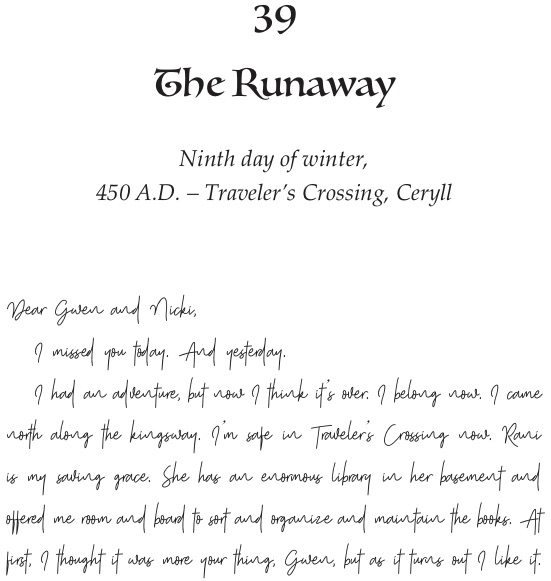
I added chapter 39 in November, after the book was well into the publication process. I was prompted by a cousin who remarked (without having read the book) that I shouldn’t have just one handwritten chapter.

I considered this out loud with her. I don’t remember the entire exchange, exactly, but I remember considering transposing Deric’s note to be its own chapter, then discarding the idea for some reason. It seemed important that the writing belong to Stelle, bookending the story with her writings.

Well, it’s no spoiler to tell you that that messes with the otherwise linear timeline of the book. Stelle’s first handwritten chapter is chapter 2; Gwen feels the effects of her death in chapter 3, which we then see in chapter 4. Thus, chapter 39, which is again Stelle’s writing, takes place in the timeline after chapter 2 and before chapter 3.

It also creates this morose, dreamy atmosphere that outlines and makes explicit much of what I feel was already there in the text or between the lines by chapter 38.

In terms of atmosphere, perhaps this is preferable to the cut-and-dry tone with which I otherwise portray grief throughout this book, I thought—yet at my core, I don’t like it. I never have. I like the descriptions of grief cut and dry.

In an earlier draft of this book, much more of the focus was on the grieving process. There’s a reason why I cut most of that out. The grieving process is very personal, and it’s hard for a reader to empathize with page after page of description of a grieving process that doesn’t match their own. This is why, though in my mind, Gwen’s grieving process is much the same as it was in that draft, the text is a lot subtler. It’s there, at times even explicitly, but hopefully now it’s been tempered enough to mitigate the barrier of personality.

Chapter 39 is a letter that Stelle wrote to her sisters while delirious with fever. It has some details about her life at the Crossing that this book would otherwise not mention, but mostly it’s a letter of love and regret. If ever anyone thought that Stelle carried the anger with her ever since leaving Castle Dio, chapter 39 dispels that.

And yet.

The more time passes, I don’t think it’s all that important. That Stelle’s anger has long been cold is there in the text of chapter 4.

I don’t like that there’s an entire chapter dwelling on her past regrets and pain—because, in the end, she isn’t truly past the anger. It may have gone cold, yes, but as we see in chapter 4, it’s easily ignited again. Stelle has only left her anger and pain behind—she hasn’t worked through them, or overcome them.

It took me 2 months to reach this conclusion. There’s been a lot of back-and-forth of “Should I take it out?” and “Should I leave it in?” While I was swaying back and forth, my book was published.

I don’t regret it: in a strange way, it makes me feel better about the over a dozen typos I’ve found in the published book. Because those typos exist, I feel better about asking to change an entire chapter, since I’m requesting all these other changes. But because chapter 39 will change, I don’t feel as bad about the typos: because now, there’s some reason for these books to exist. They may have a lot of typos, but they’re also going to be the only ones with this chapter.

So, if you disagree with me, and feel the book is better with Stelle’s chapter 39—it’s out there, and I can’t completely take it back.

(But the year is also wrong. It ought to have been 451 A.D. — so there you have it, yet another typo.)


Kai Raine is the author of the high fantasy series What Words Have Torn Apart, beginning with These Lies That Live Between Us.

Ebook is available at Amazon (US, UK, Germany, India, Japan, Italy, France and others) Kobo, Google Books and iBooks.

Paperback is available through Barnes and Noble and Amazon (US, India, UK, Germany, Japan, Italy, France and others).

.


Share this page:

  • Print (Opens in new window) Print
  • Email a link to a friend (Opens in new window) Email
  • Share on Facebook (Opens in new window) Facebook
  • Share on X (Opens in new window) X
  • Share on Tumblr (Opens in new window) Tumblr
  • Share on WhatsApp (Opens in new window) WhatsApp
  • Share on Reddit (Opens in new window) Reddit
  • Share on Pinterest (Opens in new window) Pinterest
  • Share on LinkedIn (Opens in new window) LinkedIn
  • Share on Telegram (Opens in new window) Telegram

Like this:

Like Loading...

Why I Write

Posted on January 7, 2018January 12, 2018 by Kai Raine

I believe that stories can set the mind free.

The largest portion of each of our minds is tightly constrained by the realities that it has experienced, and the beliefs of the cultures and societies that have surrounded it. This necessarily limits our ability to understand, and therefore accept, the experiences and beliefs of those with vastly different experiences, or from starkly contrasting societies or cultures.

I have heard this neatly summed up as “tribalism,” “preference” or “comfort,” but it’s so much more than even all three of those combined. It’s biology. Our brains are not designed to be accepting of all our fellow humans. Our brains are designed to survive, and we respond more strongly to fear, sadness and anger than we do to joy, comfort or happiness.

Even in love, often portrayed as the most positive of all emotions, many of us have internalized negative emotions as loving or romantic, because this is how our brains are hardwired to feel strong emotions; and because our culture, society and media have a tendency to propagate this. Pick up an average popular romance novel, and generally speaking, the driving emotions will feature jealous anger, fear of loss, sorrow of unfulfilled wanting, and/or sexual frustration. Sometimes, a character reveling in one of these emotions is even portrayed as noble.

This is not to say that this is bad, or wrong. But it is a pattern—a reality too often accepted without question. All too often I have heard people (women especially) complain about the abusive dynamics that would result if they were to take popular romance fiction tropes as reality. Even more often I have watched these tendencies unfold harmfully in reality before my eyes.

It doesn’t matter if our stories are that way because our brains are hardwired that way, or vice versa. (I’d guess it’s a bit of both.) The resulting effect is the same, though what those effects are will vary from person to person, and culture to culture.

Most of us don’t possess the natural capacity to shrug away these cultural norms and simply accept what we are taught is socially unacceptable. For example, this could be someone coming walking down the street naked, or a family member announces out of the blue that they are in a polyamorous partnership.

In fact, even if we do possess that natural capacity, as we get older, our brains grow less plastic. It becomes increasingly difficult to accept starkly different viewpoints that we’re encountering for the first time.

Young or old, this is especially difficult in reality. Certainly, there are any number of non-fiction books out there that would help us see how the minds works. But how many of us seek those out? In my experience, we tend to seek to read the views we agree with; when we read the views we disagree with, it usually seems to be for the purpose of figuring out how to counter those views.

I have no doubt that there are people out there who seek out the exotic and the new and the things they find instinctively repugnant with the intention of learning to accept and empathize with these views. I commend and admire these people.

I am not one of them.

Let me be clear: I do not advocate for cultural acceptance over legal action. If someone comes to from a culture where it is acceptable to murder someone over an insult, and that person commits murder, I believe that that person should suffer the consequences and go to jail. (Ideally, I would advocate for rehabilitating them to be able to live in a society without committing murder on the regular, but that’s another story.)

This is not because I believe murder is an inherently evil act. I believe our society and the people in it are much healthier and happier in a world where murders are not condoned.

As a person, I aim to be able to accept any act that does not do anyone harm of any kind.

As a writer, I aim to write compelling stories without bringing any of my own judgements to weight the scales. Should you read my stories and choose to judge my characters as good or evil, that is your choice—and, perhaps, the influence of the perspective of the character through whose eyes you are experiencing the story.

But I aim to make it difficult to easily call any one character purely “good” or “evil.” Instead, I showcase their humanity and tragedy, adversity and perseverance. Everyone is human. Everyone is flawed. There is only understanding and empathy, or the lack thereof. There are protagonists and antagonists, and I have no doubt that some of readers would overlook the protagonists’ flaws and the antagonists’ virtues.

That’s fine. I don’t hold my opinions and intent over anyone’s interpretations. I only aim to make it a little harder to simplify it into an “us and them” scenario.

I write my books first and foremost to be enjoyable to read. My debut novel is indie-published, but believe me when I say I put every effort into making sure it looked as good and read as easily as I could manage. Reading a novel shouldn’t be a chore, or homework. But as you enjoy the story and the plot and the characters, I will try to subvert your expectations—not to shock you, but to make you think and try to empathize with a character whose choices and beliefs have stopped following the expected narrative.

Sometimes these are based on things I wished I saw in stories more often, or indeed at all. More often than not, it’s what feels right for that character in that story when I break through some small part of my own mind’s barrier of what I think should be.

This is one of the reasons why, so far, I’ve written principally for a young adult and middle-grade demographic. Writing for these age groups means my characters are of similar age, and have minds that, while already holding some strong beliefs, can more easily accept that these strong beliefs are not consistent with new facts that come to light.

The effect that this style of writing has had on my psyche has been remarkable. I feel like I can see far more clearly than I ever could: not just my made-up worlds, but reality.

Come and join me in my world. Read my book, and tell me what you see.


Kai Raine is the author of the high fantasy series What Words Have Torn Apart, beginning with These Lies That Live Between Us.

Ebook is available at Amazon (US, UK, Germany, India, Japan, Italy, France and others) Kobo, Google Books and iBooks.

Paperback is available through Barnes and Noble and Amazon (US, India, UK, Germany, Japan, Italy, France and others).

.


Share this page:

  • Print (Opens in new window) Print
  • Email a link to a friend (Opens in new window) Email
  • Share on Facebook (Opens in new window) Facebook
  • Share on X (Opens in new window) X
  • Share on Tumblr (Opens in new window) Tumblr
  • Share on WhatsApp (Opens in new window) WhatsApp
  • Share on Reddit (Opens in new window) Reddit
  • Share on Pinterest (Opens in new window) Pinterest
  • Share on LinkedIn (Opens in new window) LinkedIn
  • Share on Telegram (Opens in new window) Telegram

Like this:

Like Loading...

These Lies That Live Between Us: Book Trailer

Posted on January 4, 2018 by Kai Raine

Three sisters: the heir, the airhead and the dead. Parting in anger, each attempts to confront the looming threat of invaders practicing forbidden magic in her own way. However, they soon learn that history is not so simple—much like their bond to one another.

This is the start of a fantasy epic about family, adventure, love, loss and the ever-changing interpretation of history long gone.

These Lies That Live Between Us is now available in ebook form at Amazon (US, UK, Germany, India, Japan, Italy, France and others) Kobo, Google Books and iBooks! Paperback is now available from Barnes and Noble!

Share this page:

  • Print (Opens in new window) Print
  • Email a link to a friend (Opens in new window) Email
  • Share on Facebook (Opens in new window) Facebook
  • Share on X (Opens in new window) X
  • Share on Tumblr (Opens in new window) Tumblr
  • Share on WhatsApp (Opens in new window) WhatsApp
  • Share on Reddit (Opens in new window) Reddit
  • Share on Pinterest (Opens in new window) Pinterest
  • Share on LinkedIn (Opens in new window) LinkedIn
  • Share on Telegram (Opens in new window) Telegram

Like this:

Like Loading...

Indie Publishing: A Summary of the Pros and Cons

Posted on January 3, 2018January 5, 2018 by Kai Raine

…as I have experienced them in publishing my novel through Gatekeeper Press. Let’s jump right in.

Pro 1:

Achieving a professional look while retaining complete (or as near as I could tell) creative freedom. The fonts, the cover art, and everything were all up to me to choose.

Pro 1.5

That said, I didn’t have to choose everything. If I didn’t give them specifics, GP has people who know what they’re doing who could work off of the basic information about the book.

Con 1:

Going in as a wide-eyed newbie to bookmaking, I learned that there were a lot of things that I never knew I had a preference about until I was sent something, and my gut screamed, NO!

Pro 2:

I was always able to request changes, and they would be made.

Con 2:

Asking for changes to a finished book file (which I ended up doing a couple times) does cost money, on top of the original fees.

Pro 3:

My author manager Takako was very nice about these costs, waiving fees where she could.

Con 3:

Because I was publishing through Gatekeeper Press rather than simply doing everything myself, there were some restrictions: for instance, sometimes I would want a certain font, but they would not have that licensed.

Pro 4:

With regards to the above “restrictions,” these were not insurmountable. For instance, if I offered to pay the licensing fee for a font, they would use that font.

Ultimately I didn’t do this, though I came very close. I was very picky about a handwriting font that went into the book. At the start I told them I didn’t care what font they used but it should look like “a wayward teenage girl,” but ultimately the font they chose just didn’t click with me. So I finally sent a list of fonts I liked and told them if they had none of those, I would pay the licensing fee for one of them. Fortunately, they had one font from that list, and used that.

Con 4:

I had no idea how picky it’s acceptable to be. (I still don’t know. I wonder if some of the people who had to deal with me and my learning curve are exhausted with the lists of changes I can demand now and then.) Ideally, I wanted to try to build these relationships so that if I decide to go this publishing route with the next work, I could happily work with the same people. I’m not entirely sure I succeeded.

Pro 5:

If I could articulate a question I had about the process, I could always ask my author manager at GP. It was okay that I didn’t know everything.

Con 5:

Because I knew nothing, a lot of my questions only came to me after the point at which it would have been ideal to ask it. Even now, I sometimes suddenly realize that there’s some detail that I never thought about and wonder, is it okay this way? Does it need to be changed? If I want to change it, between the fees and the work I’m making other people do, is it really worth it?

Most recently, this happened when I suddenly realized that the cover design isn’t credited to the artist on the copyright page. Of course—I never specified, because I never thought that was optional; and I never checked to see if it was there or not. But at this point, I’ve decided to let it go: the cover artist has seen the “final” version and didn’t mention it either, and there’s a page about her in the book, so the information is there inside the book.

Pro 6:

I really, really like the end result. (At least for the ebook, and the digital interior of the print book. I haven’t actually seen a physical print book yet.) I know I couldn’t have made it look like this on my own in this amount of time. Maybe I could have figured it out eventually, but the amount of stress it would have caused trying to figure out what I wanted it to look like when I didn’t know half these details would have been considerable.

Con 6:

It was frigging expensive. My book probably cost in excess of $2500 (this is an estimation because I haven’t yet been billed for all the changes made, or for the page count).

Don’t get me wrong: this was a choice, and I don’t regret it. I could have made it cheaper, but I didn’t. I had paperback and ebook formatting and distribution, a complete line edit, and probably close to 20 content changes (i.e. changes to the text after file is already complete) from Gatekeeper Press, plus an extra 10% on top of that to expedite the process (back when I thought I could get it out by Christmas). I paid an artist for the cover art.

All of this could have been done more cheaply, but I didn’t because I wanted it to look like a book I would pick up and read without knowing anything about it.

Pro 7:

Once I made the decision to do this, I could make it go fairly quickly. It took two months because of all the changes I kept wanting, which is already quite fast, but if I’d wanted fewer changes or known what I wanted from the start, it would have gone even faster.

Con 7:

Once the book is out, that’s it. You’re on your own. GP has no marketers or publicists, though they do say they can refer you to people they trust.

This is big. You can’t just publish your book and wait for it to sell—especially for someone like me, whose readership is still limited to people I know. It has to get promoted somehow, pushed out to a readership.

Marketing myself could easily cost me as much as it cost to make the book, if not more; but being too cheap in marketing could mean this book never reaches an audience beyond my circle of family and friends. Marketing myself effectively would take skill and experience. I’m still at the start of my learning curve here. Maybe in a year or two I’ll be in a position to talk about marketing as an indie author, but at this moment I’m not.

Honestly, I think it would be foolish to think about making money on this book. Yes, the listed prices are presently a touch higher than the costs of production. But as soon as there are other books published, I plan to drop the costs of this one to the cost of production. Currently, I view it as a foothold to use when marketing the next book.

If you happen to be someone who wants to help me in this, you can absolutely do that! Sharing and recommending my book on social media will help the book reach past my circle into your circle. If you’re someone who read and liked the book, I need (positive) reviews on Goodreads, Amazon, Barnes and Noble, and other such sites. Those are extremely valuable, because the presence/absence of reviews and the ratings can be the critical difference when one stray stranger comes across the book and is contemplating whether or not to buy it.

That said, I don’t want anyone to feel like they have to do this. If you write a positive review, please let it be because you liked the book, not because I asked you to.

If the book isn’t your cup of tea but you want to help me anyway, I’m looking to distribute my book by donating it to libraries in my area, and asking friends to do the same (I’ll provide the books). Contact me if you want me to send you a copy to donate to your library. Alternatively, if you can convince your library to purchase a copy, that would be even better! It will be (and may already be) available from Ingram, which distributes to libraries, and NACSCORP, which distributes to universities in the US.

Pro 8:

The reach of this book as distributed through Gatekeeper Press seems much better than I could have achieved on my own. As stated above, it’s available with distributors to universities, libraries and retailers, as well as all the usual sites like Amazon, Kobo, Google, iBooks and Barnes and Noble, which is great!

Con 8:

The reach of the book may have been even better had I gone through traditional venues.

Pro 9:

Having control over every step of this book including how it’s publicized makes me more driven to sell it, to get it to a larger audience. There’s no guarantee it would have succeeded no matter how it was published, and no one knows why this book is worth it better than I do. Traditional publishing would have meant that the book was out of my hands, and perhaps I wouldn’t have felt so strongly about it anymore after the editing and cover art and approach to marketing.

Probably if it had flopped, I would have shrugged and moved completely on to the next book rather than saying to myself, “Okay, that didn’t work. So what do I have to do to get this to people?”

I’m closer to my book now than I was even when I made the decision to go to Gatekeeper Press, and I’m determined to do everything I can to help it find its audience.

Con 9:

But if it had been traditionally published, I would have sold a lot more copies than I can dream of now, even if the book had flopped. I wouldn’t have born the costs of production, so any money lost wouldn’t have been my burden to bear.

Pro 10:

I retain all of the rights, and receive 100% of the royalties. This doesn’t mean much of anything right now, but in the unlikely instance that this book ever becomes middling to big, this will be a big deal. Then again, I’ve never been traditionally published, so maybe there are advantages already that I’m not aware of.

Pro 10.5:

Most of the cons, as you may have noticed, are about the financial burden, of a first-time-only variety, or about the financial burdens that resulted from my inexperience. If I were to go through this process again, I could mitigate some of them.

Ultimately, a lot of the financial stuff comes down to a time vs money question: which would I rather save? If the answer is money, then I have to be careful not to overload myself, because this could easily become overwhelming and crushing both mentally and emotionally. I was aware of this, which is why I chose to pay to have a lot of it done for me this time around.

But having done it once, I feel that there are some things (like formatting the interior for the print copy) that I’m sure I could manage myself without having to pay for it next time. This would also ease the burden of constantly asking for changes.

Having done this once will especially improve the way I approach marketing next time. Now that I have one book published, as long as I keep trying to get it out to a larger readership, maybe in another novel or two I’ll be able to start thinking about earning money on my work.

If I were to do this again….

I’d start focusing on marketing and publicizing the book more than a couple weeks before it comes out. Which means I’d also not bother trying to rush publication. That time could have been valuable if I’d focused on using it to build hype.

I’d go into formatting with a list of fonts I like for absolutely every part, or at least my preferences (like that there should be serifs, even on headers)—or I’d do it myself.

I’ll think about details like chapter headers before I submit the manuscript.

I’d submit an ARC to reviewers. I’d do some sort of event on the date of publication, trying to sell the books in person.

Related to making sure there was less rush, I’d make sure there was less stuff on my plate. Trying to do holidays and make a book all at once was a lot.

It would probably be smart to hire editors twice next time: a developmental edit after I feel like I like the manuscript, and a line edit when I’m ready to publish (because I assume there would be a lot of editing in between).

In summary…

It’s frigging expensive, and frigging scary. At the moment, it’s looking more like a money-draining hobby than a career.

But that’s ok. My goal going in was that if I can reach 100 readers I don’t personally know who genuinely like my book, that’ll be enough for now. That’s nothing if I want to make any of the costs back that I put into the book; at the same time, it feels like a ridiculously lofty goal right now. Lofty, but (I hope) achievable.

These Lies That Live Between Us is now available in ebook form at Amazon (US, UK, Germany, India, Japan, Italy, France and others) Kobo, Google Books and iBooks! Paperback is now available from Barnes and Noble!

Share this page:

  • Print (Opens in new window) Print
  • Email a link to a friend (Opens in new window) Email
  • Share on Facebook (Opens in new window) Facebook
  • Share on X (Opens in new window) X
  • Share on Tumblr (Opens in new window) Tumblr
  • Share on WhatsApp (Opens in new window) WhatsApp
  • Share on Reddit (Opens in new window) Reddit
  • Share on Pinterest (Opens in new window) Pinterest
  • Share on LinkedIn (Opens in new window) LinkedIn
  • Share on Telegram (Opens in new window) Telegram

Like this:

Like Loading...

Beginning My Journey in the World of Indie Publishing: Why Indie Publish?

Posted on January 2, 2018January 3, 2018 by Kai Raine

As you may be aware, my first novel, These Lies That Live Between Us, came out today. It’s thrilling and exciting, but also frightening. One of the reasons it’s frightening is because I chose to go the route of indie publishing. I’d like to share some of the lessons I’ve learned over the course of this journey, but first I have to start with the question: why indie publish?

The internet seems to be awash with people with strong feelings about indie vs traditional publishing. Some declare that traditional publishing is dead or too biased in favor of established names and commercialization. Others declare that authors who indie publish are people who didn’t want to put in the work to be accepted through traditional routes, or whose book simply wasn’t good enough.

I used to feel that traditional publishing was the only way to go. It was San Francisco Writers’ Conference 2017 that changed my mind. I met agents, publicists, indie authors, and indie publishing companies there, all of which contributed to my understanding that this will be an uphill battle no matter which route I should choose to take. There are pros and cons on all sides, and ultimately all that rests on me is to make a decision.

I received cards from four agents at the “speed-dating” event intended for authors to find an agent at the conference. I left the conference with the resolution that I would pitch to the four of them, and if they all rejected me, I would self-publish.

I sent to three agents and got rejected. I never submitted to the fourth, whom I had saved for last, because she was my first choice and I felt so sure that if anyone will take it it’s her. (The idea was that if the other three rejected me, I would learn and perfect my pitch before it got to my first choice.) I lost her card with the instructions for my submission, and was frighted of being rejected simply because my query hadn’t fulfilled her requirements stated on the card.

Then, one fine day in early November, I realized—I could publish at the end of the year and take another novel to SFWC 2018. Maybe I could have it published by Christmas and convince people to buy it as gifts. (Eventually the Christmas deadline was abandoned in favor of a more realistic one that allowed for corrections, of which there were many.)

Most likely, one of the factors that contributed to this decision was the length of time that I’ve been shopping this manuscript around. I’d been agent-hunting for a solid year, without even a manuscript request. Even at the conference, some agents in casual conversation explained to me that the premise of my book sounded unmarketable—too cross-genre to have a clear target demographic. I couldn’t deny it: even as I market it as a YA novel now, I’m frightened of the disappointment that some readers might suffer when they realize that it doesn’t do what they expect—most particularly because none of the “romances” will lead anywhere.

Of course, looking at the facts in retrospect, I see an entirely different picture. My pitch improved dramatically after the conference, but I only sent to three agents after that point. In the middle of submitting to these three agents, I cut over thirty thousand words of internal monologue and other nonsense, and added a third storyline. The first fifty pages changed dramatically in September 2017, and I never submitted to another agent after that.

Above all, with everything I learned at the conference, my story has gone from having potential to being great. I’m not trying to brag or sell myself, though you may not believe me. It astonishes me, the changes that those eight months brought to my story. If I had to estimate, I’d say that 80% of the book was rewritten in those eight months. In many ways, it isn’t the book I brought into the conference anymore. I was proud of that book, but editing it was an exhausting chore. I love editing this new one. Even when I start out not wanting to, the story sucks me in and I have trouble stopping.

That’s never happened to me before with something I’ve written. I didn’t think it was possible to enthrall myself with my own words and my own story.

So perhaps my mistake was not submitting to agents after all these edits were made, and I knew beyond a doubt that I written something worth reading. Maybe if I’d done that, I’d now be starting a journey into the world of traditional publishing. Or maybe I’d still be sending my pitch around, writing and rewriting it ad infinitum.

The fatigue of a year of rejections wasn’t so easily reasoned away by confidence in my new and improved manuscript, especially when there wasn’t a single voice around me supporting traditional publishing. The voices around me were instead urging me to self-publish and put an end to this so I could move on to the next work and asking when this book would be published. I can say without a doubt that the voices around me became the determining factor that effected my decision, for better or for worse.

And so the decision was made.

The only caveat I had about self-publishing was that if I was going to go that route, I needed my book to meet professional standards. No one picking up the book would know that it was self-published just by looking at it, or by reading it.

So I turned to Gatekeeper Press. I met Rob and Tony at the conference, and even there and then was strongly compelled by their style. From the moment I made the decision to self-publish, I knew I would do it through them. Gatekeeper Press is at its core a distributor—they make sure the book ends up on every ebook retailer it can—but they offer every step of the publishing process for a flat upfront fee, including cover art, formatting and editing.

The same day that I decided to abandon the last agent and self-publish, I emailed Rob and scheduled an appointment with Tony on their website. Five days later, I signed on with them.

Now, less than two months later, I’m a published author! I understand the world of publishing a lot better than I did even a mere two months ago. I’m glad I made this decision, and hope this book eventually finds a readership that loves it as much as I do.

These Lies That Live Between Us is now available in ebook form at Amazon (US, UK, Germany, India, Japan, Italy, France and others) Kobo, Google Books and iBooks! Paperback is now available from Barnes and Noble!

Share this page:

  • Print (Opens in new window) Print
  • Email a link to a friend (Opens in new window) Email
  • Share on Facebook (Opens in new window) Facebook
  • Share on X (Opens in new window) X
  • Share on Tumblr (Opens in new window) Tumblr
  • Share on WhatsApp (Opens in new window) WhatsApp
  • Share on Reddit (Opens in new window) Reddit
  • Share on Pinterest (Opens in new window) Pinterest
  • Share on LinkedIn (Opens in new window) LinkedIn
  • Share on Telegram (Opens in new window) Telegram

Like this:

Like Loading...
  • Previous
  • 1
  • 2
  • 3
  • 4
  • 5
  • 6
  • …
  • 8
  • Next

Recent Posts

  • Redefining “Which Quarantine House” Memes
  • The TLTLBU Sequel Woes
  • The World Wide Web (No, the Other One)
  • Hello, Blog Readers…
  • A Quick Guide for Writing Diverse Characters (Whose Backgrounds You Don’t Share)

Recent Comments

  • Cliftonguest on Route 2: The Highway That Was My Personal Obstacle Course
  • Kai Raine on Mt. Kawanori Hike (Including Hyakuhiro Falls)
  • Edith on Mt. Kawanori Hike (Including Hyakuhiro Falls)
  • Kai Raine on Mt. Kawanori Hike (Including Hyakuhiro Falls)
  • Onlinepharmacycanada on Mt. Kawanori Hike (Including Hyakuhiro Falls)

Archives

  • April 2020
  • February 2020
  • April 2019
  • December 2018
  • November 2018
  • October 2018
  • September 2018
  • August 2018
  • July 2018
  • May 2018
  • April 2018
  • March 2018
  • February 2018
  • January 2018
  • August 2017
  • June 2017
  • May 2017
  • April 2017
  • March 2017
  • February 2017

Categories

  • Cognitive Science for Writers
  • Eating and Cooking
  • Hiking and Nature
  • Indie Publishing & Marketing
  • Interesting Strangers
  • Keeping Ahead of the Shadows
  • Murphy's Law of Transportation
  • Stories and Me
  • The Othered
  • Travel Stories
  • Writing for a Globalized Audience

Meta

  • Log in
  • Entries feed
  • Comments feed
  • WordPress.org
© 2026 Kai Raine | Powered by Minimalist Blog WordPress Theme
%d