Kai Raine

Author of These Lies That Live Between Us

Menu
  • About Kai
  • Books
    • These Lies That Live Between Us
  • Short Fiction
  • Non-Fiction
  • Media & Events
    • Contact Me
  • Blog
  • 日本語
  • Reviews & Interviews
Menu

Blog

Off to the Japan Writers Conference!

Posted on October 11, 2018 by Kai Raine

I’m flying to Otaru for the Japan Writers Conference today!

It’s been a hectic couple of weeks, and I’ve been a mess all day today: rushing out of a room to go do something only to realize that I left behind something crucial.

But most things are done. Just 2 things left: submit my scholarship application (yes, I’m officially back in academia as of this month), and do my mandatory health check. Then it’s off to the station to catch my bus to the airport for a dizzying sequence of transportation that will get me to Otaru past midnight! (Yikes…?)

I deliberately haven’t prepared anything for my presentation at the conference. I thought I’d just make a list of memories and angles for myself, and have that with me, and turn my “lecture” into a more participatory sort of thing, where I cater what I talk about to what the audience wants to get out of my talk. It might be a terrible idea, but given the topic I chose, I figure that this is better than preparing a powerpoint presentation to bombard audiences with.

I’m in the last slot on the last day, so I’m also expecting that there won’t be that many people.

So—if I’ll see you in Otaru, I look forward to meeting you!

If not, wish me luck!

Share this page:

  • Print (Opens in new window) Print
  • Email a link to a friend (Opens in new window) Email
  • Share on Facebook (Opens in new window) Facebook
  • Share on X (Opens in new window) X
  • Share on Tumblr (Opens in new window) Tumblr
  • Share on WhatsApp (Opens in new window) WhatsApp
  • Share on Reddit (Opens in new window) Reddit
  • Share on Pinterest (Opens in new window) Pinterest
  • Share on LinkedIn (Opens in new window) LinkedIn
  • Share on Telegram (Opens in new window) Telegram

Like this:

Like Loading...

The Inappropriate Song—or, How My Childhood Mind Thought in Absolutes

Posted on September 1, 2018November 26, 2022 by Kai Raine

–Note: This blog post uses fake names for real people to protect their privacy.–

A few days ago, I woke up and scrolled through my music library for a song I felt like writing to.

I landed on Fukai Mori, or “The Deep Forest” by Do As Infinity. As I listened to the lyrics, I realized that this was the first time in seventeen years that I was letting myself enjoy this song without shaming or judging myself for it.

Not because there’s actually anything wrong with the song—but because of something that happened in school when I was eleven years old, and the way that I interpreted it.

I was in fifth grade, and was required to join a school committee. There were several, including the health and gym committee, the environmental committee, the student council, and the announcement committee. The idea was that each committee had certain responsibilities, but also a certain leeway to choose what they wanted to do, as long as it was somewhat in the purview of their committee.

I joined the broadcasting committee. I didn’t care at all about broadcasting, but I very much was an indoor child. Most of the other committees had responsibilities that involved going outside (such as the health and gym committee, or the environmental committee). But most of the broadcasting committee’s responsibilities were limited to sitting at the soundboard in the broadcasting room. We got to play the designated good morning song at 8 every morning, and the designated goodbye song at the end of school hours ever afternoon. During lunch hour, we got to play DJ and broadcast whatever music we felt like. When necessary, we would make announcements. At the end of the school year, we broadcasted live interviews with individuals of the graduating class during lunch hour.

The point is, I liked the idea of responsibilities that were largely limited to sitting in a room, playing music.

Now, one of the first things on the agenda that year was to change the designated goodbye song, which hadn’t changed in the last 6 years. Being a recent transfer, I was disappointed—I very much liked the existing goodbye song.

Ever the opinionated child, I voiced this thought. I was immediately overruled, though not unkindly.

“We get it—it’s new to you. But the rest of us have been listening to this song every single school day since the first grade. We’re sick of it.”

We nominated songs we liked and took a vote. Being that it was the goodbye song, the nominations tended to be songs that were on the slower, more subdued side of the spectrum.

The song that won with an overwhelming majority was Fukai Mori: the song that started off this blog post.

As our president declared that decision made, the two teachers chaperoning our meeting started conferring in low voices. Shortly after, the vice principal stepped forward.

“Listen,” he said gravely. “I’m sorry, but I have to object that song. Normally, I wouldn’t do this. We want you to make your own decisions for yourselves, and we want to respect the choices you make. But Ms. Yokohama and I think that maybe you don’t understand that song, and why it’s inappropriate as the daily goodbye song. So I’m going to explain why we think you should choose something else.”

He proceeded to write out the lyrics of the first verse on the blackboard.

深い深い森の奥に 今もきっと In the depths of the deep, deep forest
置き去りにした心 隠してるよ Lie the abandoned hearts hidden there
探すほどの力もなく 疲れ果てた The exhausted people have no strength to search
人々は永遠の闇に消える And fade into eternal darkness

Having written this out, he turned back to us and asked, “Can anyone here explain what the word ‘abandoned’ means?”

We were silent. I knew the word from a book. It had been about a girl who’d met a man who promised to marry her, then “abandoned” her. It just meant left behind, I thought.

Now, under umbrella of the teacher’s disapproval, I tried to understand if I’d misunderstood the word. Did it mean that something “inappropriate” had happened before the man left? I wondered. My mind exploded into possible stories, based on what I assumed to be “inappropriate”: I assumed that the word meant toilet stuff, violence or sex.

The teacher went on to define the word, and explain the lyrics. I’m pretty sure I was only half digesting what he was saying, already lost as I was down the rabbit hole that is my single-minded brain.

It was only the other day as I listened to the song that for the first time, I realized that the word I didn’t understand wasn’t abandonment. It was the word inappropriate.

Fukai Mori a nice enough song. There’s no “bad language” or rudeness or meanness in the lyrics. It’s simply that they’re a little fatalistic and depressing.

The teacher wasn’t telling us we shouldn’t listen to it, or even broadcast it. We’d played it during lunch break before—probably several times, given that this was during the height of that song’s popularity—and no one had ever said anything about it. We didn’t play it again after this—but maybe that was because we were all a little embarrassed by having to be lectured by our teacher about why a song about how life takes everything away from you, leaving behind nothing but deception and lies, is inappropriate as a daily goodbye song, especially considering the impression it might leave on the first and second graders.

I got caught up in the rabbit hole of my own mind, and misunderstood the problem. I thought in absolutes, and if a song was inappropriate as a goodbye song, then I thought it must be inappropriate in general. But I believe I might have been the only one with that hang-up.

The teacher didn’t even veto the song. He explained to us why he thought it was a bad idea, and asked us to vote again. It was the president of our committee, a serious bespectacled sixth grader whom I couldn’t help but admire, who stepped up after the teacher was done and vetoed Fukai Mori before taking a new vote on the remaining songs.

To be completely honest, I don’t even remember what song we did vote for. I only remember that for years afterwards, I couldn’t enjoy Fukai Mori because I was convinced that it was this shameful thing, even though I couldn’t exactly explain why.

It’s interesting to think that I understood exactly what the lyrics meant on a surface level, but it never occurred to me to look deeper, and consider the dark implications and the impressions that might leave on young children if they heard those words everyday and internalized them. So what if small children hear that life takes everything away and just leaves you with lies and emptiness? I thought. It’s true. That couldn’t possibly be the root of the problem—there must be some weird violent or sexual subtext to the word “abandonment.” (I was a precocious child, already diving headlong into the teenage angst phase.)

Now, seventeen years later, letting go of that weird, misunderstood hangup and simply permitting myself to enjoy the song, I think…

It’s okay. Nothing amazing. A little too teen-angst-y for me now. But there’s nothing wrong with some good angst. It’s certainly nothing to be ashamed of. It never was.

Share this page:

  • Print (Opens in new window) Print
  • Email a link to a friend (Opens in new window) Email
  • Share on Facebook (Opens in new window) Facebook
  • Share on X (Opens in new window) X
  • Share on Tumblr (Opens in new window) Tumblr
  • Share on WhatsApp (Opens in new window) WhatsApp
  • Share on Reddit (Opens in new window) Reddit
  • Share on Pinterest (Opens in new window) Pinterest
  • Share on LinkedIn (Opens in new window) LinkedIn
  • Share on Telegram (Opens in new window) Telegram

Like this:

Like Loading...

How to Write an Asexual Love Story—and Why

Posted on August 31, 2018September 1, 2018 by Kai Raine

I’m trying to write an asexual’s love story right now. No, I don’t mean a non-sexual love story. There will in fact be a bit of sexual content, because the protagonist has to learn that not wanting to have sex, not enjoying the rush of hormones, is not the same thing as either prudishness or some sort of virtue.

That said, this is a complicated thing to write, and I want to talk a bit about it.

The Manuscript That Demands to Be Written

Let me back up. I just wrote a quarter of a novel manuscript in half a week.

This wasn’t something that I had on my list of planned projects. I’m not even sure that this is something that will ever see the light of day, beyond a handful of carefully selected beta readers. But it is something close to my heart, that I feel strongly compelled to write.

My biggest challenge in the writing of this story is attempting to create a compelling love story narrative where the love interest—as well as the reader, perhaps—writes off the protagonist as a potential romantic partner very early on because of her sheer disinterest in sex.

This novel is about many things, but one of those things is the story of a woman who tells herself that she is simply picky about partners—who comes to accept that no, it’s not the partners that she’s disinterested in, but the sex and the hormones. She is capable of experiencing attraction, but finds it deeply unpleasant. The rush of hormones, the way it turns her head, the giddiness, the blind dedication—these things that make the start of a relationship the best part to many people are what make her averse to it. She would rather just skip to the part where the attraction is muted and the relationship is characterized by comfortable familiarity.

Is this proper “Asexuality”, as per the LGBTQA+ label? Does it matter? Not to me.

Because this is my sexuality that I’m trying to portray. I label it asexuality. I used to label it demisexuality. At the end of the day, you can call it whatever you want. I’m contemplating the idea of throwing all the labels into the story at different points, to highlight all the possible angles I’ve considered it from, or just dropping them all and letting the readers decide for themselves.

Other Asexual Love Stories

Here’s the thing—fan fiction is the only place where I’ve ever read love stories of the asexual/aromantic/demisexual variety. Oh, certainly, I’ve read books or seen movies where you could interpret a character to be one or more of the above, but these aspects are subtle, and possible to ignore. Not so in my story.

Well, the fan fiction template is not much use going into writing an original novel. Fan fiction can do these things for a few reasons:

  • When reading fan fiction, people tend to search for the pairing that they want to see. If you post an asexual Harry Potter/Draco Malfoy fic —and just to be clear, I’m making this up, but I wouldn’t be surprised if it exists—then some Harry/Draco shippers will read it. You don’t have to go through the trouble of investing your readers in the characters and their relationship. Their interest comes pre-packaged the moment they click on your story.
  • Thanks to the advent of Archive of Our Own, people also search fan fiction by tags. So if you write, for example, a Monkey D. Luffy/Trafalgar Law fic where they are asexual and aromantic respectively, people interested in asexuality and aromanticism will find it by searching those tags. And even though the reader may not necessarily be a Luffy/Law shipper, they might go, “Huh, I know and like those characters, and this is an intriguing idea. Let me take a look.” And once again, you’ve hooked them purely through premise and knowledge of a fandom.
    • And this one is a real fic that I liked very much—it gave me a lot to think about. You can read here if you’re interested.

It’s harder to try and build this from the ground up. I have to get the reader deeply invested in the characters, as well as a developing relationship—which is challenging enough in ordinary circumstances. But I need the reader to be invested in a relationship where the two characters in questions are of “incompatible orientation” according to conventional wisdom. And I don’t want to do this by deliberately tricking the reader. I hope that the protagonist’s emotions, and her lack of self-awareness will effectively obfuscate her…unusual feelings about sexuality for long enough that the reader has time to get to know her and become invested in the main relationship.

But I’m not counting on it.

“But Asexuality Is Just Self-Denial”: Proving a Negative Through Story

When I talk about my asexual characters—because this isn’t the first—I get a lot of flack for it. I’m cashing in on a trend, I’ve been told. It doesn’t really exist, people have said to me. That asexuality is a temporary state of people who simply haven’t yet met “The One”; that asexuals are simply deluding themselves due to society’s brainwashing; that asexuality runs contrary to biology—these are all views that have been shared with me. Not necessarily with regards to my character, mind you. Some of these have been said to me, about me, even before I adopted the label of asexuality and applied it to myself.

Obviously, they are wrong about me, and so I disregard these opinions with regards to my character, too.

Here’s the problem, though.

I’m trying to tell an asexual’s love story—a story where, through falling deeply in love with one person, the protagonist comes to realize and accept how deeply she doesn’t care for romance or sex. This love interest is an exception to how she has always been, and how she realizes that she continues to be underneath the attraction.

If this doesn’t seem paradoxical, let me reframe it for a second.

What I’m trying to do is basically like trying to tell the story of a female character realizing she’s a lesbian by falling really and truly in love with a man for the first time, and recognizing how he is the exception to her experience of her feelings with men.

Arguably, I feel like given the widespread acceptance of the Kinsey scale, that would make slightly more sense—in this situation, it would be a story of a woman who rates perhaps a 5 on the Kinsey scale.

Just like it’s impossible to scientifically prove a negative, it’s hard to tell a story about something that’s totally absent. But an exceptional situation that creates feelings that the protagonist has never experienced before or after, despite the contradictory stories she tells herself and everyone else about who she is? That’s something I can do.

That’s what I’m writing.

(I just have to figure out how to structure it. Just, indeed…)

Share this page:

  • Print (Opens in new window) Print
  • Email a link to a friend (Opens in new window) Email
  • Share on Facebook (Opens in new window) Facebook
  • Share on X (Opens in new window) X
  • Share on Tumblr (Opens in new window) Tumblr
  • Share on WhatsApp (Opens in new window) WhatsApp
  • Share on Reddit (Opens in new window) Reddit
  • Share on Pinterest (Opens in new window) Pinterest
  • Share on LinkedIn (Opens in new window) LinkedIn
  • Share on Telegram (Opens in new window) Telegram

Like this:

Like Loading...

Route 2: The Highway That Was My Personal Obstacle Course

Posted on August 19, 2018August 19, 2018 by Kai Raine

It’s been a long time since I blogged a travel story. All my Murphy’s Law of Transportation stories so far have been about public transportation, so today I’d like to talk about the

This coming week my sister’s moving out of the apartment in Amherst, Massachusetts where she lived for her college career. I spent a large chunk of the last two years living with our aunt and grandparents in Middlesex County, Massachusetts, so I got to visit her semi-regularly. The trip between the two towns was pretty straightforward, but typically took about an hour and a half, though it could be longer with traffic. Most of that trip was spent driving on Route 2.

How I loathed Route 2.

For some reason, for the first year, one of every two ventures I made out to Amherst featured nerve-wracking moments. On Route 2, where the speed limit is 55mph, but everyone typically seems to drive at 70-75mph.

Random tangent: I’m guessing that traffic slows down when the weather is bad. My trips were always voluntary, so I never made the drive when the weather looked like it might make things difficult. After leaving Route 2, there was another 30+ minutes of driving on windy, hilly roads in the middle of nowhere. The prospect of ice and rain was not a welcoming one on these roads. I have made the trip out of Amherst in bad weather, but not the trip to Amherst. Which is what this post is about.

The stress of these events—3 of which I remember vividly—contributed to my stress at the prospect of making the drive, making my trips out to Amherst less frequent than I had expected them to be.

Incident #1

The first incident happened during maybe my second or third drive to Amherst, when I was still not quite sure of the roads. There was a lot of traffic that day, but going quite fast. I was in the row of cars in the left lane.

(Route 2 is a 2-lane highway for most of this trip, except the last stretch where it became a 1-lane highway. Yes, the left lane is supposed to be for overtaking, but when there are people stubbornly doing the speed limit, the left lane becomes the 70mph travel lane, while the right lane is the 55mph travel lane.)

The car in front of me was a bigger car than mine. (Not unusual. I drove a 2-door VW GTI.)

In front of that car was a big truck. You know, one of those gigantic things.

So that’s the scene: me in my little car, on an unfamiliar highway that goes on forever. I just have time to see something red by the truck’s tires when the car in front of me swerves.

Now, I learned to drive in Germany, where it was strictly drilled into me to never swerve when startled. I was taught to break.

So I don’t swerve. But I can’t break suddenly either, because the car behind me is quite close. I break, but slowly. I just have time to register that it was one of those bright red plastic fuel containers, and then I’ve driven over it. (Between the wheels, at least.) I hear it dragging for a few seconds, then I hear it release. In the rearview mirror, I see the car behind me swerve, but not enough, and catch the container under itself, too.

When I got back to my grandparents’, I took the car to a local mechanic just to check that I hadn’t hurt anything. He was very nice, checking the car and reassuring me that there was no damage at no charge.

Incident #2

This time, I was relatively accustomed to the drive. But the gas container incident hadn’t quite faded from my memory on the day that I was driving down Route 2, again in the left lane, again in traffic.

Around the same place where the gas container incident had happened, again I encountered an obstacle! This time, it was a white plastic trash bin, lying across the left half of the lane.

Luckily, everyone was swerving around it so it was visible a good few seconds beforehand, rather than coming out of nowhere. The cars in the right lane were spaced far enough apart that this was not too difficult.

Incident #3

By this point, the it had become a bit on an inside joke among my friends that Route 2 was my personal obstacle course.

I was also growing more confident in my driving. After all, if I’d managed not to get into an accident so far, I was doing pretty well. So my guard was perhaps a little bit lowered one sunny day.

I drove without incident past the areas where I’d formerly encountered obstacles. Traffic was sparser than usual, but both lanes were moving fast: probably 65-70mph.

I was more than half way through my course on Route 2 when I rounded a corner and saw, just a split second before I had to react…

A couch.

Sitting there blocking off 2/3 of the left side of the right lane was a couch. Not lying sideways or anything, no. It was upright, looking perfectly comfy and innocent.

Fortunately, being in the left lane (as usual), I only had to veer to the leftmost side of my lane to avoid the couch.

People in the right lane were swerving into the shoulder, and I’ve never been so relieved to see that there was a shoulder to the highway. (Sections of this highway don’t have a shoulder; had this happened in any of those places, this would have undoubtably resulted in a massive pile-up.)

In summary: driving is dangerous, but I’ve somehow been extremely lucky.

Share this page:

  • Print (Opens in new window) Print
  • Email a link to a friend (Opens in new window) Email
  • Share on Facebook (Opens in new window) Facebook
  • Share on X (Opens in new window) X
  • Share on Tumblr (Opens in new window) Tumblr
  • Share on WhatsApp (Opens in new window) WhatsApp
  • Share on Reddit (Opens in new window) Reddit
  • Share on Pinterest (Opens in new window) Pinterest
  • Share on LinkedIn (Opens in new window) LinkedIn
  • Share on Telegram (Opens in new window) Telegram

Like this:

Like Loading...

Unexpected Comfort Gauge: the Bathroom Metric

Posted on July 16, 2018July 16, 2018 by Kai Raine

Over the years, the recurring conversations that I’ve had have not always been the obvious ones.

One of the more surprising recurring conversations is that on the cleanliness of bathrooms.

“Why are American Bathrooms So Dirty?”

When I was five, and had just moved to Japan, there was a girl at my preschool who became my friend. She was loud and rowdy, and one of the first things she did was lead me into the bathroom, where we opened every stall one by one. The stalls were small, with little preschooler-sized toilets, and did not have locks on them. So we opened each one, regardless of whether there was someone inside, screamed, “Benjo!” (a rude term for “toilet”) and slammed the door, moving on to the next stall.

I’ll call this girl Snowy. Snowy was born in the US, but her parents moved back to Japan while she was still an infant. She had no memory of living there, though she did recall a visit or two.

One day, Snowy inexplicably had an outburst.

“Why are American bathrooms so dirty?” she asked me.

At that point, I’d been living in Japan for a year or so. I’d used all sorts of bathrooms: seated and squatting, old and new, clean and filthy.

Still, when she said that, four specific bathrooms came to my mind. The pristine bathrooms of my grandmother’s house, and the old, shabby-looking (but clean) bathroom of our apartment. Then I thought of the old, dirty, squatting bathroom I’d used in the baggage claim area of Narita Airport, and the clean, seated bathroom I’d used when we were at Niagara Falls.

So, “American bathrooms aren’t dirty,” I countered at once. “Japanese bathrooms are dirty!”

“No they’re not!” she shouted. “Japanese bathrooms are clean! American bathrooms are dirty!”

War commenced. We argued until the teacher intervened. I don’t remember what she said. I do remember that the bathroom question was one we never resolved.

The Moral of the Story is…

My mother and I read a lot of Chicken Soup books back in the 90s, volumes that we would laboriously bring over from the US, or occasionally receive in packages from friends and family.

There was one particular story—I would guess that it was in Chicken Soup for the Kid’s Soul—that I remember with particular clarity.

It was a story about two children arguing over a sphere.

“It’s black,” said one child, standing on one side of the sphere.

“No, it’s white,” said the other, standing on the other side.

They argued until the teacher came and picked them up, and moved each of them to the other side of the sphere.

“Now what color is it?” asked the teacher.

“White,” said the first child.

“Black,” said the other.

This story confused me. Why were they so determinedly standing on opposite sides of the sphere? Why did they never attempt to move to the other side?

It was a stupid story, I thought.

I remembered this fight I had with Snowy about the bathrooms. Now, if only that fight had been so easily solved by moving a few steps, I thought.

For some reason, the story of the sphere and my fight with Snowy became entwined in my memory anyway. Years later, I finally understood that we were simply generalizing based on a few limited experiences. I’d seen a few dirty bathrooms in Japan, and she’d seen a few dirty bathrooms in America, and we’d decided that this was how it always is—even though I, at least, had definitely seen clean bathrooms in Japan, too.

Somehow, the dirty bathrooms had expanded through my consciousness, until it seemed suitable to define an entire country by them.

It took me even longer to see that there was a reason the story of the sphere had stuck to that memory. Metaphorically, the two had always been the same story.

Deja Vu: Italian Bathrooms

23 years after Snowy and I railed at each other over whether American or Japanese bathrooms were dirtier, I was sitting in a bar drinking with a handful of my Japanese friends. One of them was a sweet girl whom I’ll call Casta, and she was talking about her honeymoon in Italy.

“That must’ve been nice,” said another girl, whom I’ll call Lapis.

“Oh, but the bathrooms there are so dirty,” said Casta.

“Really?” blinked Lapis.

I snorted into my drink. “It depends on the bathroom,” I said lightly, thinking of all the bathrooms I used during the year I lived in Italy.

“Oh, it was so bad,” said Casta, almost gleefully. “I couldn’t believe how dirty they were.”

“I guess that’s how it is overseas,” said another friend, a guy I’ll call Shin.

“It depends on the bathroom,” I said again, a little more emphatically.

“Yeah,” Casta agreed, looking at Shin, not me. “That definitely wouldn’t happen in Japan.”

“It depends on the bathroom,” I said yet again, but it didn’t matter.

Shin was launching into his anxieties about his upcoming honeymoon to Australia—his first time overseas, and the place being his wife’s choice, not his.

He railed at the prospect of dirty bathrooms in foreign countries.

I listened for a while without arguing, because suddenly, I understood. This wasn’t about the bathrooms. It never had been. It wasn’t even about countries.

It was about discomfort, or unhappiness.

The Bathroom Metric as a Comfort Gauge

When I was a child and a teenager, my parents—as most traveling parents do—planned trips without consulting me or my sisters.

There were a few trips in particular that we made in India when I was a teenager, that I desperately didn’t want to go on. From those trips, I mainly remember grimacing at dirty bathrooms in the places where we stayed.

Perhaps, I realized, when we are unhappy or uncomfortable and looking for something to blame, a dirty bathroom is the perfect outlet. Disgust at a dirty bathroom is totally understandable, and easy to express. It’s a thing we can look at and say to ourselves, “See? Of course I’m unhappy. Look at this place!”

It’s an explanation that means we don’t have to look inward at ourselves.

Unhappiness, of course, can from anywhere. It comes from families, or marriages, or friendships, or self-loathing. It often throws us off-balance if we realize that things that we always took for granted, opinions we always thought were common sense, are actually entirely up for debate.

Traveling—or moving—is one of those strange actions that can force us to stare these unhappinesses in the face. Routine, home and the familiar give us all the nooks and crannies to stuff our problems away like we’re teenagers hiding secrets from our parents. But traveling strips all those things away, and suddenly we can see the problems we’d forgotten about.

When we suddenly are faced with misery—of course it’s easier to look at a dirty bathroom and say, “See? This is how this place is, and that’s why I’m miserable,” perhaps conveniently ignoring the dirty bathrooms we’ve seen elsewhere that we didn’t expand to define an experience or a country.

Of course, this gauge is predicated on encountering a dirty bathroom, which is objectively an unpleasant experience. One might still complain about a dirty bathroom one had to use despite enjoying a trip overall. Complaining about a dirty bathroom isn’t, by itself, a predictor.

But when that experience is part of someone’s description of an entire country? Then it would seem that one has some dissatisfaction with the country, or the trip, that one desperately wants to express somehow.

The Country of Unbearably Spicy Food

But what if there is no dirty bathroom to blame?

When I was seven, we also made a week-long family trip to China. I was miserable. My parents were both attending a conference, so a strange woman babysat us. But my sisters didn’t like her much—perhaps they couldn’t understand her English through her accent—so I ended up looking after them. I liked taking care of them on occasion, but after the first day, I was tired and bored. We had to stay in the apartment all day, and there was nothing to do. My sisters were two at the time, and equally unhappy, which contributed to my frustration.

I was in the throes of my horse-obsession then, so at the end of our trip, my mother bought me a beautiful hand-carved wood decoration of two horses galloping majestically through a wave-like design. I loved the horses, but the trip was engraved into my memory with misery anyway.

Perhaps all the bathrooms we encountered were clean, because I don’t remember them. What I do remember is one evening when I was particularly hungry, but the food was so spicy I could hardly stand it. I was hungry enough to force it down, but I didn’t enjoy it.

And so for over a decade, China remained in my memory The Country of Unbearably Spicy Food.

I even almost forgot the misery of being stuck in an apartment taking care of my also-unhappy sisters. After my mother’s death, I was looking at my horse carving, trying to decide whether it was worth trying to keep it.

One of my sisters recalled being frustrated that I was the only one to get a gift like that.

And suddenly, I remembered:

My sisters crying when our mother bought me the carving, because they wanted to get something too.

My mother explaining to them that this was a special gift, because I’d been a good big sister to them.

I felt delight at hearing that—delight that I attached to the horse carving alone. Meanwhile, the one night of spicy food continued to define my entire food experience in China—and, at times, China itself.

Back to the Bar…

Casta and Shin were deep in rapture about the dangers of international travel, gushing about the comforts of Japan.

I listened to this for a little while in silence. I felt I could see Shin’s fear and insecurity in his new marriage. Casta was a romantic soul in an arranged marriage, so that her honeymoon was not a blissful getaway did not surprise me. On both counts, I sympathized with them.

I decided to discuss the literal level of the conversation anyway.

“You’re talking about the bathroom at the place where you stayed, right?” I asked Casta. She nodded. “Not everywhere has dirty bathrooms.”

“Sure,” Shin countered. “But there’s no way to know that stuff before you go.”

“There are review sites online,” I countered back. “When you look for a hotel, find one of those review sites, and read some of the reviews. If there’s something like dirty bathrooms, there’ll be reviews that say so.”

Casta and Shin stared at me, as if I’d just blown their minds.

Again, I sympathized, because in a way, I figured I had. I’d taken away an excuse they had to justify their feelings—for the night, at least. Memory is a funny thing, and perhaps the next day they went right back to thinking as they had been before.

A Final Note

It’s a dangerous thing, presuming to know how other people feel. I don’t actually know what Snowy, Casta or Shin were thinking or feeling. Mostly, I’m just guessing at the root of their complaints. It’s not impossible that one or more of them is just particularly clean or even germaphobic, and complaints of dirty bathrooms were, truly, about nothing more than dirty bathrooms.

However, such complaints of my own have never been at the roots of any such unhappiness I’ve experienced over the years. Such complaints for me—and there have been many, increasing in complexity as I’ve gotten wiser to the tricks of my own mind and confusing myself has become a more elaborate process—were always a short-lived band-aid over some underlying unhappiness.

Perhaps it’s just me. Perhaps it’s just a prevalent mentality in Japanese culture.

But when I look outwards, that’s what I see.

At the end of the day, I just find it funny that it so often comes back to dirty bathrooms.

Share this page:

  • Print (Opens in new window) Print
  • Email a link to a friend (Opens in new window) Email
  • Share on Facebook (Opens in new window) Facebook
  • Share on X (Opens in new window) X
  • Share on Tumblr (Opens in new window) Tumblr
  • Share on WhatsApp (Opens in new window) WhatsApp
  • Share on Reddit (Opens in new window) Reddit
  • Share on Pinterest (Opens in new window) Pinterest
  • Share on LinkedIn (Opens in new window) LinkedIn
  • Share on Telegram (Opens in new window) Telegram

Like this:

Like Loading...

On Blogging and Vlogging and All That Jazz

Posted on July 14, 2018July 14, 2018 by Kai Raine

As you might have noticed, I’ve been dabbling in vlogs and video essays lately. Don’t worry about breaking the news to me—I’m aware that they’re not that great. I don’t think it’ll ever be my medium the way writing is. I have to script a video to be happy with it, I’m not an engaging screen presence, and I’m so out of my depths with editing. I’m still a writer, through and through.

I have been learning certain things about myself. Like how when I’m talking, I’ll often drop articles, or alternate between past and present tense, or just use the wrong words like it’s nothing.

But for various reasons, I do want to become more familiar with the process, and for certain topics, a video—if I can manage not to fail at the performance and editing part—does land with more potential impact than words on a screen.

At the same time, my flatmate Edith is a YouTuber—she’s just starting out, but takes it very seriously.

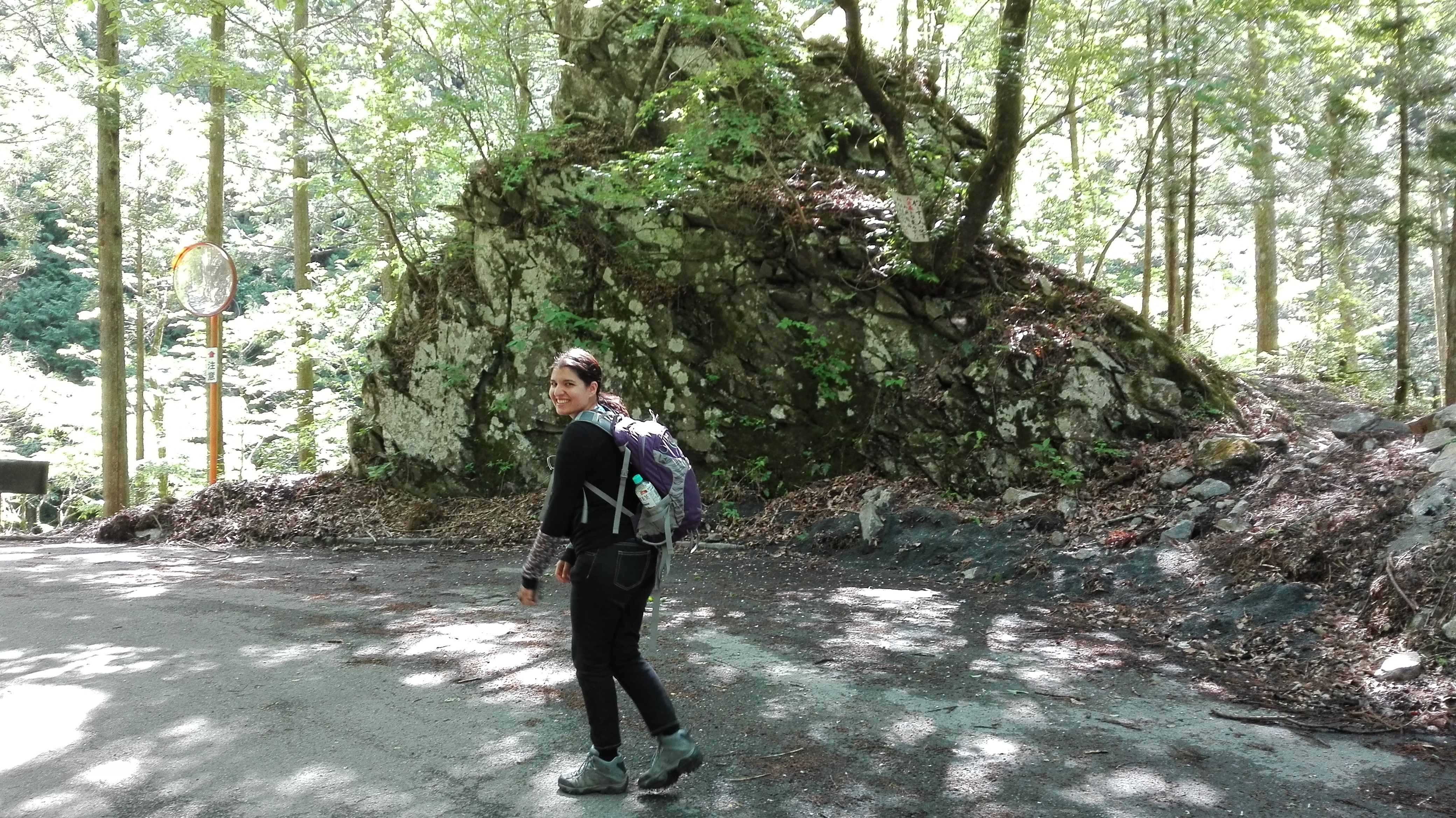
So when we decided to go hike Mt. Kawanori together back in the beginning of May, I suggested we vlog it.

We decided to alternate whose channels we’d post hikes to, and played rock-paper-scissors to decide who’d start out. I only “won” by a technicality, since we didn’t realize that we each play it differently, and after a few failed attempts Edith decided that my technical win was still a win.

In trying to pare down the video to 10mins, I realized that mostly I just wanted to keep in the interplay between me and Edith.

That’s how I am in my stories, too—dialogue and relationship dynamics all the way. Scenery? Pfft.

Yes, it’s there, especially in These Lies—it had to be. But there are still scenes where I feel the clunkiness. I find pleasure in hearing and touch and imagination; not so much in visuals. So when I write a character admiring scenery, no matter how hard I try, I inevitably feel like it’s not good enough.

So in the end, even though it was a vlog, it turned mostly into us talking. This isn’t bad, per se, but I don’t have the editing skills to back up this creative decision. So it just comes off as a video of two people talking about a hike while they hike, interspersed with miserly glimpses of scenery.

I even cut out most of the information about the hike.

We’re not explaining things very well, I thought when I was rewatching the parts of the video where Edith and I explained things. It would be much better if I write this all out. I think I’ll just write a blog post to accompany the vlog, with all the information.

I finished and uploaded the video, and started this blog post while I waited for it to upload, so that I could cross-link the two.

It was only after it was all done, and I went to sleep and got up this morning and looked at it again that I realized—the blog post with the vlog embedded in it works so, so much better than the vlog alone linking to the blog.

Oh well. You live and you learn. But next time, I’m thinking that this will be the intended format.

And hopefully, in time, my editing skills will improve, as well.

Share this page:

  • Print (Opens in new window) Print
  • Email a link to a friend (Opens in new window) Email
  • Share on Facebook (Opens in new window) Facebook
  • Share on X (Opens in new window) X
  • Share on Tumblr (Opens in new window) Tumblr
  • Share on WhatsApp (Opens in new window) WhatsApp
  • Share on Reddit (Opens in new window) Reddit
  • Share on Pinterest (Opens in new window) Pinterest
  • Share on LinkedIn (Opens in new window) LinkedIn
  • Share on Telegram (Opens in new window) Telegram

Like this:

Like Loading...

Mt. Kawanori Hike (Including Hyakuhiro Falls)

Posted on July 13, 2018July 15, 2018 by Kai Raine

Ever since I found this list of 15 beautiful hikes within Tokyo, Mt. Kawanori was at the top of my hike wish list. (Okay, fine, Hajijo-jima actually was first. But Mt. Kawanori seemed easier to access, and sometimes I arrange my wish lists with practicality in mind.)

A few months ago, my flatmate Edith expressed interest in this hike as well, so the two of us tried the hike during Golden Week (the first week of May).

We filmed a vlog that it took me two months to get around to editing, which you can watch below.

For anyone interested in a more detailed itinerary, just scroll to underneath the video.

Getting There

We traveled to Okutama Station, which is all the way at the end of the Ome Line.

Generally speaking, the easiest way to get there is to take the Chuo Line to Tachikawa, then the Ome line to Ome, then the other Ome Line to Okutama. But on holidays, there’s a line called the Holiday Okutama Express that stops along the Chuo Line, so all you have to do is get to a station where it stops, and voila! You can get on a train all the way to Okutama in one go. The caveat is that this train splits along the way, so you have to be careful that you’re in a car that’s headed for Okutama.

Once you get to Okutama Station, there’s only 1 exit. You get to the exit, and you turn right without crossing the street—that’s where the #1 bus stop is.

Here you have to take the bus to Kawanori-bashi, or Kawanori Bridge.

(Note: be careful if you read kanji, because the mountain is usually written 川苔山 while the bridge is usually written 川乗橋.)

Normally, you’ll want to check the schedule in advance, because the buses don’t go more than once an hour.

But because we went in a high-demand time (i.e. Golden Week), there were special buses at the #1 bus stop that went specifically to Kawanori Bridge.

The bus stops right in front of the starting point for the hike.

In our case, we aimed to be on the Chuo Line by 6:30am; we started out a touch late, but still were on a train around 7. We reached Okutama, I believe, around 8:30-8:45.

Our Hiking Route

In terms of landmarks, this was our route:

Kawanori Bridge Bus Stop -> immediate detour just after the first big bridge -> Hyakuhiro Falls -> taking the right at the fork, so that we were on the southern loop toward the summit -> minor exploration on a ridge (not included in the video because there wasn’t much to see) -> Mt. Kawanori summit -> northwards from the summit to the major junction -> One-no-yama-no-kami (or, God of Mt. One; this is a brief flat area with a parking lot and a small shrine) -> Hatonosu Station.

The trails are extremely well-marked. We had some confusion just after we took the righthand turn to take that southern loop, when we seemed to come to another, unmarked junction. But it probably wasn’t a real junction at all, and we made the right call in which way to go. (It was to the right, again.)

We reached Kawanori Bridge around 9:15, but took a moment to have breakfast there, so we started hiking at 9:30. Including a 20-ish minute break at Hyakuhiro Falls and a few detours, we reached the summit around 13:30, where we took another 20-minute break. After that, we mostly walked continuously, though we did take a rest at One-no-yama-no-kami and again between there and the town where the hike ended. We reached Hatonosu Station around 16:30.

This is a map of our route. The hiking sites estimate that our hike was 13km long; however, we’ve since determined that the hiking sites only take into account horizontal distance and not vertical, so make of that what you will. The summit is just to the left of that last circle where the route heads basically straight south south east. As you can see, there’s a fair bit more distance to walk down than up.

As for elevation, this was our elevation map. Again, I’m a little dubious as to its accuracy. We seemed to experience more flats on our way down than this depicted, but maybe that’s also simply that we were fairly exhausted by the time we reached that point. (Note: the x-axis depicts distance traveled in km, and the y-axis elevation in m.)

Getting Back

Getting back is easy. The trains in Hatonosu Station are regular. Unless you’re out extremely late—which is inadvisable anyway—you should have no trouble getting a train back into town.

TIP: there’s a public hot spring bath at Kawabe Station, just after Ome on the way back into Tokyo. It’s geared towards hikers, and is a wonderful place to stop and refresh yourself after a long hike. They have several types of baths, indoors and outdoors, soap, shampoo and conditioner readily available, and two types of saunas. They also have massages and a restaurant. They have storage for large luggage, but usually the lockers are big enough to contain any backpack I take hiking. You can rent towels for a small extra fee, so all you really need to bring is a change of clothing.

Comments

This was a really fun hike! It’s supposed to be really nice in all seasons, so I might hike this mountain again.

Taking detours and breaks into consideration, I think we made pretty good time! We mostly just slowed down at the last segment of the downhill, where the hike finally started to get us in the legs.

The downhill was hard on our knees. We really slowed down on that last leg, and we were both walking a little funny in the end. But the hot springs helped with that quite a lot!

Edith was a bit dubious about the idea of planning another thing after such a big hike, but in the end she was really delighted with the hot springs!

So—really great hike, and a great day.

Footnote: if you’re wondering about the vlog/blog hybrid format of this post, I wrote another post about it here.

Share this page:

  • Print (Opens in new window) Print
  • Email a link to a friend (Opens in new window) Email
  • Share on Facebook (Opens in new window) Facebook
  • Share on X (Opens in new window) X
  • Share on Tumblr (Opens in new window) Tumblr
  • Share on WhatsApp (Opens in new window) WhatsApp
  • Share on Reddit (Opens in new window) Reddit
  • Share on Pinterest (Opens in new window) Pinterest
  • Share on LinkedIn (Opens in new window) LinkedIn
  • Share on Telegram (Opens in new window) Telegram

Like this:

Like Loading...

(The Start of) An Impassioned Defense of Fan Fiction

Posted on May 31, 2018 by Kai Raine

**This blog post is cross-posted from my review blog, The Storybooker.**

As a general rule, I don’t post reviews of fanfics on my review blog.

Certainly, there was one notable exception—an instance in which said fanfic was eventually published as a book for sale, incidentally.

Lately, I’ve begun to ask myself: Why is that?

This is my “dirty” secret: I read a lotof fanfic. As a matter of fact, even when I’m too depressed to do anything else, when I can’t stand up or go outside or even pick up a book—even then, I read fanfics.

It would be accurate to say that fan fiction is my comfort genre of choice. Back in the days when I had bookcases’ worth of books at my fingertips, sometimes my comfort reads would be familiar, beloved books. Alas, those days are gone, and I don’t have the means to keep many books anymore. As such, most of the books that I do still have are books I haven’t yet read or books of particular sentimental or intellectual significance to me—none of them are comfort reads. Thus, I resort almost exclusively to fanfics for comfort.

Despite having reviewed that one work fanfic on this site, I now note that I never made a tag. I still vividly remember defending my choice to review it at the start, as if it was a shameful thing to be reviewing a fanfic alongside “legitimate” books.

But this year, since I published my own book and started reviewing the works of other self-published authors, I’ve experienced first-hand that the world of self-published novels is not that dissimilar to the fanfic world. In the world of self-published books, it’s easy to wind up with a work that, especially compared to a traditionally published book, is badly in need of an editor. Choices in these stories can be reflective of the fact that the author had no one to put a foot down and tell them no—in other words, they can be self-indulgent, lacking in sensitivity, bewildering or confusing to readers, and all manner of other things not generally found in traditionally published books.

Now, this could be—and usually is—viewed as a huge mark against self-published books. I used to see it that way too. But when I read Amidst Honeysuckle, Promises and Forbidden Things, something strange happened. By all ordinary metrics of an original novel, it should have been a complete disaster: grammar, punctuation and capitalization are almost comically freestyled, the plot depicts choices and circumstances with little to no regard for the real-world psychological and societal ramifications of those things except as serves the plot, and each and every character’s physical description is listed with hair color, eye color and physique—even when said characters have little to no part to play in the story. And for about a third to half of the book, I did think it was a disaster—until something clicked and I realized, I just have to think of this as a fanfic. And next thing I knew, I’d finished it—not particularly irritated or worse for the wear. I could even see the appeal it might hold to some, even if that appeal is no longer something I can appreciate myself.

This shift got me thinking. Why did that one thought make such a difference? If I can read fanfics of a quality that I wouldn’t accept from a book, then surely the problem was never really with the quality, but something to do with my perception. Why is it that we tend to separate original fiction from fan fiction so starkly? Fifty Shades of Gray and the way it was originally published—rife with errors, barely edited from its original fanfic form except for the requisite name changes—and that patently appealed to a very wide audience nonetheless.

Could it be that hang-ups on things like grammar, story structure and psychological ramifications are an elitist way of looking at stories? At the end of the day, the thing that matters most is appealing to an audience. Are there people with whom a story resonates? Are there people who want to spend their time reading it? If a story that fails at grammar, structure and psychology nevertheless gains people who want to read it, with whom it resonates—that story is still a success.

I became a fan of the YouTuber Jenny Nicholson after I watched her read and make fun of the fanfic Trapped in a Island with Josh Hutcherson (and yes, that is the title: grammatical errors and all). This story, she exposited, had 48300 hits on Wattpad (as of the day that I’m writing this, the number has risen to 70100 hits). The fanfic is abysmal, by regular story metrics. And yet, clearly it does resonate with a lot of people—even if we assume that all readers since Jenny’s video are reading it ironically, and that before Jenny’s video, about half the readers were reading it ironically, that would still be 24 thousand sincere readers—and personally, I think that a whole 20 thousand people independently reading a story ironically seems a little unlikely.

In story critique, perhaps we spend too much time paying attention to what stories shouldbe, at the expense of seeing what is.

True that neither of the aforementioned Amidst Honeysuckle…Forbidden Things nor Trapped in…Josh Hutcherson were stories that appealed to me. Yet there are other fanfics out there that I read and genuinely enjoy. Not only do I enjoy them—I learn from them. There are fanfics that I regularly cite as being a shining example of some storytelling technique that I admire—except, up until now, I’ve always shied away from calling it a fanfic when I cite it. “This book I read once,” I’ll say instead, deliberately vague and misleading whomever I’m speaking to.

For some reason, it can seem like a shameful thing to admit, enjoying fan fiction as sincerely as I often do. I didn’t even realize how ashamed I was behaving about this hobby of mine until I started thinking about it.

The thing is, quality isn’t even that difficult a problem to get around in the fanfic world anymore. With the advent of AO3 and the filters on FF.net, looking for a high-quality fanfic is no longer the disorganized bog of senselessness that it was when I discovered the world in the ’90s. It’s easy to do a sort of crowd-sourced quality control by sorting stories by popularity. Generally speaking, if you go to a fandom or pairing you like (assuming that the number of works in that fandom or pairing are fairly substantial) and sort it by popularity—meaning by number of kudos on AO3 or favorites on FF.net—you can find at least a few stories that are well worth your time on the first page of results.

And there are quite a few fanfics out there that I adore, at a level not dissimilar to my favorite original novels.

So, I’m making a change: I’m going to be posting reviews of some fanfics. Make no mistake—these will be some of my favorites, so things that I highly recommend. I won’t waste your time talking about the mediocre (for now). I want to showcase the wonderful pieces that the fan fiction genre can produce—especially the beautiful stories I love that can onlyexist as fanfic. By which I mean, they can have no Fifty Shades of Gray style novel adaptation. Many of these stories are too intrinsically linked to their fandom to make sense if removed from that.

And that, for me, is part of the appeal.

In addition to the reviews, I’m also planning a few essays, and maybe a vlog or two on the subject of fanfic: its worth for readers, its value for writers, as well as an analysis of the positive aspects of stories that can almost exclusively come out of fan fiction.

Whether you love fan fiction or are skeptical of this notion, I invite you to join me.

Share this page:

  • Print (Opens in new window) Print
  • Email a link to a friend (Opens in new window) Email
  • Share on Facebook (Opens in new window) Facebook
  • Share on X (Opens in new window) X
  • Share on Tumblr (Opens in new window) Tumblr
  • Share on WhatsApp (Opens in new window) WhatsApp
  • Share on Reddit (Opens in new window) Reddit
  • Share on Pinterest (Opens in new window) Pinterest
  • Share on LinkedIn (Opens in new window) LinkedIn
  • Share on Telegram (Opens in new window) Telegram

Like this:

Like Loading...

Of Vulnerability, Molehills and Mountains

Posted on May 10, 2018 by Kai Raine

As you may be aware if we are friends on Facebook, I am currently in a depressive episode.

This makes this a first for me: publicly talking about my depression while I’m still in the depths of it, dark and cold and frightened and exhausted.

Of Vulnerability

As I talked about in my post about social anxiety, this segment was not originally intended to be a self-help column. It was meant to promote understanding among those who want to better help their loved ones, and to provide encouragement for those in a similar state.

I like to present myself as together, responsible, strong, and reliable. But the truth is that there are times when I am none of those things. The truth is that virtually none of us are all those things all the time.

Depression means that there are times when it’s impossible for me to completely hide my soft underbelly from anyone. This leaves me, at those times, extremely vulnerable—to friends, family, colleagues and strangers alike.

It’s not even necessarily that anyone has to say something “wrong.” The thing that sends me falling further and further into the dark can be well-intentioned, and compassionate. Yet my mind, consumed by shadows whispering of self-loathing and hopelessness, might interpret that as an insult, or a slight—and there’s very little I can do to correct that, in the moment.

Conversations about depression are something of a taboo, or at least a very sensitive topic, in most societies. One of the reasons, in my belief, is because depression by its nature is a difficult thing to talk about for those of us who suffer from it. All it takes is one dismissal we can’t help but take to heart, one careless word from someone whose opinion shouldn’t even matter, and we’re sent careening out of orbit and further into the depths where everything becomes pointless and hopeless.

I was 17 or 18 when I was first able to admit to myself that this thing in my head was called depression. I mentioned it explicitly twice to two people over the next five years. Their responses horrified me and made me ashamed, and I clammed up again, slipping back into only vague references to the hopelessness in the presence of very close friends.

What did they do wrong, these two people in whom I confided?

Honestly? Nothing. On an objective level, there was nothing wrong with what they said.

The first was my father, who expressed relief and agreement with my self-assessment. I brought it up. I told him. He never told me, “Hey, I think you’re depressed.” He only agreed with my own assessment that I had experienced a severe depressive episode.

Bear in mind, this was not a subtle episode I’d experienced. I spent months increasingly unstable, and there was a stretch of a full 2 weeks spent literally hiding under my bed in my dorm room. I missed all my finals and tanked my GPA that semester, only managing to salvage those classes that allowed me to retake the final later. I was lucky to have a parent like my father, I know. Other parents might not have been able to see it for what it was, and blame me for my failure, nitpicking my lifestyle to find causation, and therefore fault in me. This is not a hypothetical: my mother did this. Her shame in me was palpable, and she blamed my eating habits (I’d gained quite a bit of weight during my freshman year of college).

By all accounts, my father’s understanding, his agreement with my assessment, should have been a haven. Instead, I behaved as if something grievously offensive had been said, and tried my hardest to keep our conversations away from that corner for years afterwards.

The second was a roommate of mine in grad school. I announced my “depressive tendencies” to her on our first day of meeting. I don’t know why I decided to do that: perhaps it was my way of turning over a new leaf. This roommate and I did not get along as a general rule, but with regards to this, she did the best that could be expected of anyone in such a situation. She accepted my statement; and weeks later, when I was explaining that I didn’t like exercising, she tried to delicately tell me that it might help my depression.

I hated being told what to do; I still do. It’s sheer arrogance, and it is more often a hinderance than not. This was no exception to that rule. I backtracked, informing her that I wasn’t really that depressive, I was just telling her the worst of myself early on so she wasn’t surprised. She called me weird and shrugged it off. I was left feeling shaken and small.

So, to reiterate: neither of these people did anything wrong. Yet I reacted as if they had. Why? What was I reacting to? What should they have done?

It was nothing about them, actually. It was that the admission aired one of my deepest vulnerabilities, and I was uncomfortable placing such trust in…anyone.

And yet I did nothing to help myself, for a long time.

Why? What was I waiting for?

Nothing. I was in denial, hoping it would go away. And at moments when I was forced to admit it to myself, I suppose I was waiting to be saved. I supposedly had all these friends and family who loved me—they’d save me, right? No. This is why one of my earliest posts was about saving yourself. No one knows your mind. My father tried to help. My roommate tried to help. I turned them both away, because their words weren’t the exact precise ones that I wanted to hear. Well, no one ever came up with that exact, precise combination. I learned to reach out and save myself.

Aside: A Day in the Life of a Depressive Episode

Now, I can talk about these things openly to the world not because I am less vulnerable, or because it will hurt me less when people deny parts of my mind that I know to be true, but because I have created a sense of self-worth and self-trust that I can believe in even when I can’t see it. Even when I feel like the stupidest, most worthless human to ever walk the earth, I can reach out past the noise to the stillness somewhere in me that assures me that, No. No, you know that this is the depression talking. We’ve been here before. It’s okay.

To be clear, it doesn’t feel like it does much. I could absolutely convince myself that this is accomplishing nothing, and a waste of precious energy.

The tiniest thing will still send me careening. Yesterday, I woke up at 6:30 as planned—and then stayed in bed until past 10, when I dragged myself up to start a load of laundry and get food. (Laundry was necessary because I had a flight the next day and no clean clothes.) My roommate and her SO emerged from the other room—they talked at me, and their words slid over me like I was underwater. I gave random responses and waited for it to end. Then I went back to my room and folded up my futon…and immediately lay back down on the floor and continued not to move. I forced myself up once more later to grab food, and periodically went into the kitchen for tea and water (but not nearly as often as I would have in normal circumstances).

It was near evening before I managed to get around to hanging the laundry—pointless anyway, I figured, since it was raining outside—a task I combined with grabbing dinner. All day, I was trying to tell myself that I really, absolutely, totally had to go to the lab while my brain kept up a buzz of, no no no no no people no no no no no they’ll hate me no no no no no.

As I’ve explained before, I don’t fight it. Fighting it, generally, makes it worse. I waited it out.

I waited all day. It was past 7pm that I felt a break in the panic in my mind. I seized it and went to the lab. I did the bare minimum I needed to do—the bare minimum, and I missed one little thing I was supposed to do.

By ordinary standards, this is abysmal. What a way to live, I would have berated myself in the past, pushing me further and further away from recovery.

I went to the lab, and ran a few other errands as well. I did the things I needed to do before I left (for the most part).

When I got home, I saw a text waiting. It was from an author whose book I’d promised to review a month ago, angry at me for having taken longer than promised (the promise was 3 weeks).

I did my best to be measured and calm in my response. I believe I succeeded.

It didn’t matter. I didn’t sleep until I passed out near 5am for a scant hour and 45 minutes, and the issue bugged me until it was resolved this morning.

Of Molehills and Mountains

As you will no doubt have noticed, nothing in my day was that big a deal. It was simply all in my head, looking at every anthill and molehill and seeing mountains the size of the Himalayas.

If you’ve never experienced this, perhaps it sounds trite. Perhaps it sounds like something that I should be able to correct. Perhaps it sounds more like a “way of thinking” than a “medical condition.”

Since I’ve started becoming more open about these aspects of my life, and perhaps even before that, I am often told the same thing: “You’re making life more difficult for yourself.”

The only thing less helpful than that is the dismissal, “You know, there are probably billions of people in the world who have it worse than you do.”

In the past, all either of these statements would do was compound the guilt, the self-loathing, the inability to accept myself. Now, I’ve so far been able to say, even from a depressed state, “Stop it, that’s not helping!” In a non-depressed state, I can usually smile and dismiss it.

The thing is, the molehills may still be molehills, but the lack of energy that makes them feel like mountains is very, very real. My parents used to encourage me to go exercise when they thought I was depressed. I think they thought it would be one of those things where you move, and you break through the energy-sucking thing and break out the other side. But it doesn’t work like that—at least, not for me.

The difference in my energy levels when I’m depressed and when I’m not is impossible to miss, for me.

In the past, exercising in a depressive phase felt like having an anxiety attack, which would trigger an actual anxiety attack, making everything that much worse. Now that I exercise regularly when not having an episode, that sort of occurrence has diminished; instead, I just feel weak and useless and exhausted. I’ve had to learn to forgive myself for making my workouts that much easier when I’m in a depressive episode. Moving is harder. Stamina is almost non-existent. If I lose focus, I just stop. There’s no such thing as a relaxing, easy exercise in a depressive episode. Every second is a struggle.

It can help. But mostly in the long run.

My point is this: the molehills don’t just look like mountains. They feel like mountains.

What Was Your Point in All This?

Depression tends to foster a sense of overwhelming shame of the self in me.

Society as a whole tends to shame depression, and the depressed.

These two tendency feed into each other in a disgusting, destructive fashion that’s not good for anyone. It’s a bad combo.

The only way to break this cycle, to even start making a difference, is to talk about it openly and say, This is how it is. There’s nothing to be ashamed of here.

Depression is nothing to be ashamed of. It’s okay. It can be treated. It can be lived with.

Great, So What are You Doing About That Depression Thing?

The moment I realized that I was in a depressive episode, I told the people around me—in detailed or vaguer terms, depending on their roles in my life—and they were all wonderful.

But I’ve learned that there are perils in relying too much on other people when you desperately need it. I ask for help here and there in little things, but the main things I take care of myself.

I’m stocked up with St John’s Wort tea. I’ve got pills in the mail. I found a psychiatrist that I’ll visit as soon as I have my insurance card. (I’m traveling in the meantime anyway, so it’s not the procrastination that might seem like.)

The bottom line is this: I have this core of self-trust, and an understanding of what the depression does to my mind. I know how past-me characterized myself, and I trust that she is a better judge than present-me. Using that, I can try to look at things a little more objectively, accepting that my current perspective is very skewed towards shame and self-blame. I can lean on that trust of past-me, and slowly, but surely pull myself out.

Share this page:

  • Print (Opens in new window) Print
  • Email a link to a friend (Opens in new window) Email
  • Share on Facebook (Opens in new window) Facebook
  • Share on X (Opens in new window) X
  • Share on Tumblr (Opens in new window) Tumblr
  • Share on WhatsApp (Opens in new window) WhatsApp
  • Share on Reddit (Opens in new window) Reddit
  • Share on Pinterest (Opens in new window) Pinterest
  • Share on LinkedIn (Opens in new window) LinkedIn
  • Share on Telegram (Opens in new window) Telegram

Like this:

Like Loading...

An Anatomy of a Social Anxiety Discussion

Posted on May 1, 2018May 1, 2018 by Kai Raine

Today, I’m going to write about social anxiety for both the socially anxious, and those whose loved ones may have social anxiety.

Prelude

When I first started this Keeping Ahead of the Shadows blog series, I had several areas in mind to write about, each tackling a different major aspect of life that is both difficult and that I have found ways to improve as a person with chronic depression and anxiety.

Unfortunately, the series rapidly became rather more preachy than my initial vision. It mostly consists of blog posts on things I do to combat depression. On one occasion, I’ve used it to complain about the way people define me. I’d only been doing it for a month or two before a friend of mine first called it my “self-help blog.”

But I never set out to create a self-help blog. I’m not here to tell anyone what to do. Yes, I’m a cognitive scientist—I understand neuroscience and basic heuristics. I probably have a slightly better understanding than the average person about how our minds work on a day-to-day basis. I am not a psychologist, or a psychiatrist. I’m just a person with depression and a slightly-above-average understanding of the human mind, trying to feel my way into a life that I can handle.

When I first conceived of this blog series, I had numerous subsections that I even outlined in the introductory post. In the year and few months that this blog series has existed, I’ve never addressed one of those categories at all.

So, let’s do that now. This is what I called it:

“A Social Life That Helps”

What does that even mean?

I could tell you what I meant at the time, and outline the things I planned to write about and never did.

I could—and yet I don’t see the point. Because there’s a reason I never talked about this.

Instead, I now articulate the undercurrent that made me want to talk about this in some way, shape or form: Social life is my heaven, and it is my hell.

Interactions with others is where I feel the effects of my broken, tired mind most acutely. It is where I feel the greatest despair, sorrow and hopelessness.

Yet interactions with others is also where I find my strength, and can see the beauty all around even in the darkest, coldest tunnel. It is where I can feel the greatest joy and happiness.

I can’t tell you if this is correlative rather than causal: if socialization is simply the medium through which I can feel what my mind currently holds, rather than the cause of these emotional ups and downs.

What I can tell you is that within the confines of my mind, the negative usually outweighs the positives.

From an objective standpoint, I’m pretty sure that most of the time, I enjoy people’s company, and enjoy talking and getting to know people in the moment. Yet that isn’t generally how it feels after it’s over. The moment a social interaction is over, I almost invariably sigh in relief and relax. The moment that I am in my own little world, my mind gets on its hamster wheel and clatters away. Sometimes, I focus on all the worst case scenarios and all the moments when I said the wrong things—until I’m convinced that I’m disliked, or that it may be fine for now, but everything is bound to go south eventually. Other times, I can distract myself, and prevent myself from dwelling on anything in particular…but it’s no use. Still I am left with a vague sense of doom at having to interact with these people again—I simply can no longer articulate why.

But that mostly applies to acquaintances. Interactions with close friends are a different beastie, with different hurdles and different ups and downs. These tend to be easier starting out, and are less likely to directly result in a roller coaster—but when the roller coasters hit, they can be far, far worse. Though the things I focus on may differ and the patterns may be less predictable, there is still a pattern of ups and downs. The highs from these interactions are more likely to last. Sometimes, there’s no noticeable drop from these interactions at all.

The intensity of these roller coasters varies. Sometimes, it can be subtle, a feeling so vague and undefined that I only see it upon reflection in hindsight. Other times, it can be intense, leaving me literally trembling and nauseous with terror at the notion of having to interact with people.

I have ways to mitigate these roller coasters in the interest of keeping up appearances, not going insane and just generally being able to function in society. And that was going to be the subject of this section.

Discussing a Discussion of Social Anxiety

Because social interactions seem to carry the greatest probability of destabilizing my mental state, it also feels the most frightening to talk about.

Certainly, as I mentioned earlier, there’s a discussion to be had about the cause and effect here. Is it really the social interaction that destabilizes me, or is the social interaction simply where I first become aware of the symptoms of my already destabilized mental state? If I had to guess, I’d say it’s probably a bit of both.

However, I’m not here to diagnose, or analyze cause and effect. I’m here to talk about my experiences.

Which brings me to the core of the difficulty of discussing this here. How do I discuss social anxiety, a subject that can so deeply affect me, in a way that will not lead to more difficult and anxiety-inducing social interactions? How do I discuss something that feels so inherently self-destructive in a way that is somehow constructive?

The answer to the first question, it would appear, is “carefully, and wordily.” The answer to the second is harder. My answer at this point is to ask myself another question: Whom am I looking to address with this section? The fellow socially anxious, members of the general public looking to learn more about social anxiety, or the loved ones of the socially anxious looking for a map?

I find that I’m only interested in deliberately attempting the first and the third. If there are people who fall into the second category who end up reading this and find it helpful or informative or interesting…well, of course, that would be a pleasant surprise. Emphasis on the surprise. Not because I don’t want to engage those who have no experience with this subject, but because I feel I’m too close to it to be able to give an explanation that would be truly meaningful to those who have no experience with the subject themselves.

However, let that be your judgement to make.

A Brief Overview of How I Deal With Social Anxiety

Social anxiety, to me, is a matter of mindset. I don’t mean it’s easy, or that it’s under my control. I can’t control it, and I don’t try to—much as I have discussed previously with regards to depression, trying to wrestle these tendencies and bend them to my will can only make them worse. Instead, I accept them—but try to keep them from completely taking over.

I liken it to there being two components of thought in my head: the cool-headed and rational part, and the emotional part that can get overwhelmed by anything intense—self-consciousness, guilt, fear and even love. Both of these components are necessary for me to lead a healthy life. This isn’t about cutting out the emotional part, but rather about balancing it with the rational part.

On occasions when I need to do something or go somewhere and social anxiety is the thing holding me back, I try to ask myself, “What am I afraid of?” Most of the time, I don’t have a clear answer. But that act of asking the question helps the rational brain gain just a little bit of foothold.

Am I afraid of people judging me and disliking me? If so, why? Usually, if there is an answer to these questions, the answer is not as damning as it initially feels, when inspected more closely (but not so closely that I overthink it and send myself down another anxiety spiral).

Am I afraid of repeating past failures? Guilt and fear combined can become a crippling force. Here, I must forgive myself—repeatedly. I try to remind myself of what I have learned through my past failures, and trust that I will not repeat them.

Isolation is very comfortable, to me—at times it can become too comfortable, so that leaving my comfortable isolation becomes an increasingly daunting prospect. As a general rule, I try to gauge my own needs against my wants. Do I need isolation, or do I just want it because I’m anxious of people?

There’s nothing wrong with isolation, but it must not become a self-imposed fear-enclosed cage. It’s a tightrope walk between the exhaustion that is socialization and the fear that comes with too much isolation.

Most crucial of all, when I feel it is necessary (or even just helpful), I ask friends to help me by telling me to go wherever or do whatever it is that I’m anxious about. I’m selective about who I ask to help with this: if a friend refuses, or takes this as an invitation to push me unprompted at other times, it can backfire and end up shoving me further into my shell instead. But with the right friend, a push where I needed it can make that crucial difference.

Crossing the Line Out of Anxiety

Walking through anxiety can be like pushing through molasses, with the thought “I could just turn back and find an excuse not to do this” never far from my mind. The physical distance that I have to push through this anxiety can be very short. At present, it’s never more than ten meters.

There’s usually an invisible line somewhere, in a physical location: a line where, if I cross it, the anxiety snaps away and leaves me clear-headed and alright. Usually, for me at present, this line is just outside my room or my front door—sometimes even just inside the front door. This hasn’t always been the case. In high school, the line was at the entrance to my classroom. My ride to school was always torturous: a solid half hour to an hour spent begging the universe and providence and any deity who might be listening to please spare me from this coming day with a riot or a strike or anything at all.

Yet regardless of how long or short the distance is, the struggle is no less difficult.

So, sometimes I focus only on that release. Sometimes I don’t think past that front door—I just tell myself that I’m moving one step at a time—and then I can do it. It’s astonishingly easy. I pass the line, and I can leave as if there was never any difficulty at all.

And then the fear is gone—for a time.

Helping a Loved One With Social Anxiety

Now, most everything I’ve talked about so far has been about how isolation must not last and how the fear of socialization should not take over—but this is how I would speak to a person who has or understands social anxiety. If you are not familiar with it, perhaps you wonder why I don’t simply keep myself around people until I am free of the fear.

This is because to me, socialization is inherently exhausting. There are too many stimuli: the noise, the people, the verbal and nonverbal cues, the expected actions and reactions…it wears me down. I feel exhausted after a few hours of dealing with people, but due to the nature of our society, I cannot simply slink back home. I must keep going, keep pushing, keep it up until whatever I am doing is done.

Personally, I have a lot of ways that I help myself deal with this. I usually carry a book on my person to be sure that I have a world to sink into, just in case I cannot leave but I need to pull my brain out of the fray for a moment. I live with a friend that I love and trust implicitly, who can understand this sort of difficulty in me and respect my boundaries as I set them, because I know that this keeps me from sinking as completely into isolation as I might if I were on my own—not a thing that I need all the time, but a thing that I believe is extremely helpful to me for the time being.

So, as you can see, for my own part, if I need something to help me, I can ask for it. I can ask a friend to argue with me to get me to go to a place where I don’t want to go. I can ask my flatmate to leave me alone for a few days. I can guiltlessly send a text to say that I will be late to a social gathering, allowing myself the time to collect my mind and pull myself together if I’m not able to do so in as timely a fashion as I would wish. At times—desperate times—I can even lock myself in a bathroom or some such thing to gain isolation if I really feel I need it.

This is why, if you have a loved one with social anxiety, the biggest piece of advice I can give you is to listen. Just because we have social anxiety, just because there are shadows and ghosts in our minds that do not exist in reality, does not mean that we don’t understand what we need.

To many who cannot see the shadows and ghosts, there appears to be a simple solution: just do it. Just go there. Just pull yourself together. But just because the shadows and ghosts are not real does not mean that we can simply act as though we do not see them. They feel real, and that’s all that matters, sometimes.

Depending on the person, depending on your relationship, perhaps there are instances where your loved one might thank you for pushing them when they didn’t ask you to, or pulling them out to do something against their protests.

All I can tell you is that for me, those measures are entirely counter productive. For me, the ghosts and shadows only are dispelled when I take that step out the door of my own volition. If I’m dragged, or feel forced or pressured into going somewhere, my shadows and ghosts come with me. I curl up tighter in my mind, hugging the ghosts ever closer. It becomes that much harder to break free.

But this was also not always the case. As a young child, I hated going out to social events; but my parents knew well that they only had to persuade me out the door, and however sullen I might start out, I would likely end up having fun. As I grew older, however, this ceased to be the case. Enjoyment was slow and rare to come to me if I felt forced to go somewhere, even if the intentions of the family member were good.

So, this is why I say—please listen to your loved one. And continue to listen. Just because you’ve found a formula that does work, that has worked for awhile, don’t stop listening when it no longer does.

Conclusion

There’s a lot to say on the topic of social anxiety—as a person with it, as a person used to talking to people with it.

This barely scratches the surface, but it touches a topic that is desperately difficult for me to discuss in a way that I hope was somewhat rounded, and hopefully helpful to someone, somewhere.

And now—I shake off my shadows and ghosts, and go out my door.

Share this page:

  • Print (Opens in new window) Print
  • Email a link to a friend (Opens in new window) Email
  • Share on Facebook (Opens in new window) Facebook
  • Share on X (Opens in new window) X
  • Share on Tumblr (Opens in new window) Tumblr
  • Share on WhatsApp (Opens in new window) WhatsApp
  • Share on Reddit (Opens in new window) Reddit
  • Share on Pinterest (Opens in new window) Pinterest
  • Share on LinkedIn (Opens in new window) LinkedIn
  • Share on Telegram (Opens in new window) Telegram

Like this:

Like Loading...
  • Previous
  • 1
  • 2
  • 3
  • 4
  • 5
  • …
  • 8
  • Next

Recent Posts

  • Redefining “Which Quarantine House” Memes
  • The TLTLBU Sequel Woes
  • The World Wide Web (No, the Other One)
  • Hello, Blog Readers…
  • A Quick Guide for Writing Diverse Characters (Whose Backgrounds You Don’t Share)

Recent Comments

  • Cliftonguest on Route 2: The Highway That Was My Personal Obstacle Course
  • Kai Raine on Mt. Kawanori Hike (Including Hyakuhiro Falls)
  • Edith on Mt. Kawanori Hike (Including Hyakuhiro Falls)
  • Kai Raine on Mt. Kawanori Hike (Including Hyakuhiro Falls)
  • Onlinepharmacycanada on Mt. Kawanori Hike (Including Hyakuhiro Falls)

Archives

  • April 2020
  • February 2020
  • April 2019
  • December 2018
  • November 2018
  • October 2018
  • September 2018
  • August 2018
  • July 2018
  • May 2018
  • April 2018
  • March 2018
  • February 2018
  • January 2018
  • August 2017
  • June 2017
  • May 2017
  • April 2017
  • March 2017
  • February 2017

Categories

  • Cognitive Science for Writers
  • Eating and Cooking
  • Hiking and Nature
  • Indie Publishing & Marketing
  • Interesting Strangers
  • Keeping Ahead of the Shadows
  • Murphy's Law of Transportation
  • Stories and Me
  • The Othered
  • Travel Stories
  • Writing for a Globalized Audience

Meta

  • Log in
  • Entries feed
  • Comments feed
  • WordPress.org
© 2026 Kai Raine | Powered by Minimalist Blog WordPress Theme
%d